
Traffic Accidents at ‘Perilous’ Speeds
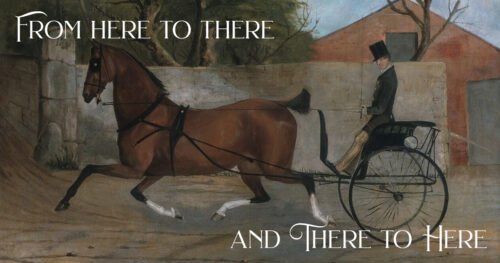
Every day we are confronted with news of traffic accidents, some horrific. It is easy to believe that these are a bane of modern society. However, in Regency England, horse-drawn vehicles were dangerous. Accidents happened frequently.
One of the biggest reasons for accidents was the state of the roads themselves. Most roads were made of dirt and sported deep ruts, mud, and large potholes. After a heavy storm, these holes could become deep enough to break a wheel or throw a driver off his seat. Sometimes mechanical parts failed. A linchpin might fall off, sending a wheel flying while the carriage was moving. Wheels and axles broke, leaving the coaches unable to move.
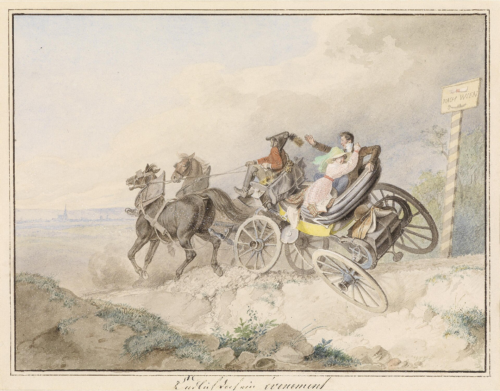
Traveling at night was dangerous because most carriages had very poor lighting. Drivers had to rely on the light of a full moon to see the road ahead. Hitting a fallen tree or a large stone in the dark could damage wheels or axles, or overturn a coach.
Speed Demons and Sporting Disasters
The most exciting vehicles of the era were also the most dangerous. Young men who wanted to look fashionable often drove curricles, which were light, two-wheeled carriages pulled by a pair of horses. These were the sports cars of their day, famous for their instability.
Title
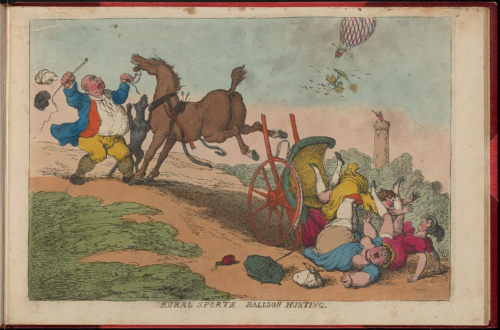
Rural sports. Balloon hunting Public Domain
Another favorite “sports car” of the day, the high-perch phaeton, was built so high that the driver sat up to ten feet above the ground. Their high center of gravity meant they could flip over if a driver took a corner too fast or if the carriage hit a bump. Some drivers were so reckless that they were nicknamed boy racers as they raced through traffic, impressing onlookers.
Even the most common vehicle on the road, the gig, a simple two-wheeled cart pulled by one horse, was prone to overturning. If a gig flipped, the survival of the passenger often depended on whether they landed on soft grass or hard stones.
Public Transport and High Stakes
Public transport was hardly safer. Stagecoaches and mail coaches also had high centers of gravity, making them prone to overturning. To stay on schedule, these coaches often traveled at high speeds, making that likelihood even higher.
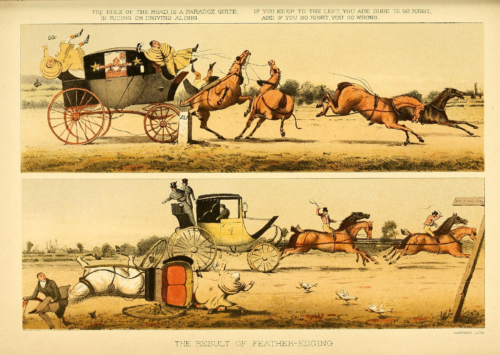
Title: Annals of the road : or, Notes on mail and stage coaching in Great Britain 1876 Public Domain
Many coachmen were known for “furious” and negligent driving. They raced against a rival company to see who could reach the next coaching inn first, in a bid to find the best customers.
Many drivers liked to drink a potent mixture of beer, gin, nutmeg, and sugar called purl before and during the journey. Passengers had little recourse against a drunk driver. Driving a team of four or six horses was such a specialized skill, a random passenger was very unlikely to be able to ‘take the wheel.’
In some cases wealthy men would bribe coachmen to let them take the reins and race the heavy vehicles against each other.
The Cost of a Crash
The casualties from these accidents could be gruesome. Passengers were thrown onto the road, against milestones, into walls, impaled on iron fences, and sometimes trampled by panicked horses. Common injuries included broken bones, deep cuts from splintering wood, and severe head trauma. The horses suffered as well. With little veterinary care available, a badly injured horse was usually shot on the spot.
Just because carriages raced along at a top speed of only 10-12 mph did not mean that traffic accidents were not a serious danger to all involved.
It’s easy to equate relatively slow speeds and quaint vehicles to relative safety. Did any of this surprise you? Tell me in the comments.
Read more about transportation during the Regency Era here.
References
The reference section for this series is VERY long, so you can find it HERE.
No surprises about the traffic accidents and resulting injuries and fatalities. Physics is physics whether horse powered or gasoline powered or battery powered. The only mild surprise was the ten-foot height of the high-perch phaeton.