
You can’t say that: Out of the Mouths of Babes
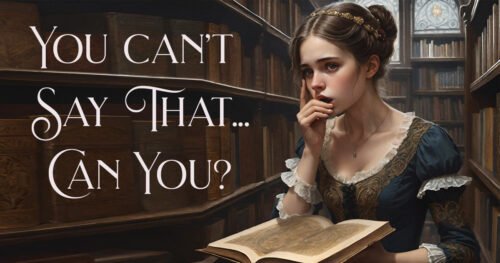
I was deep in writing mode and my characters were speaking very clearly, deep in important conversation. Suddenly something tumbles out of Little Pemberley’s mouth, with her immature grammar and sentence structure. But it was a mic drop moment that ended with: Chills raced down Darcy’s spine. Out of the mouth of babes, as it were.
Which, of course, left me scampering off to see if Darcy could have actually thought that in 1815.
The expression comes directly from the Bible, specifically Psalm 8:2, written more than 2,500 years ago. The King James Version reads, “Out of the mouth of babes and sucklings hast thou ordained strength.” The same idea appears again in Matthew 21:16, where children openly praise Jesus while adults hesitate.
Because the phrase comes from scripture, its earliest appearance dates to ancient Hebrew poetry, traditionally attributed to King David around 1000 BCE. However, the familiar English wording entered common use after the King James Bible was published in 1611.
In its original setting, the verse was not meant as a joke about children being cute. It expressed the idea that truth and insight do not belong only to the powerful or educated. Sometimes the clearest understanding comes from those without status or authority.
The English idiom developed from this biblical wording. Over time, people shortened the phrase and shifted the emphasis from strength or praise to wisdom. Today, when we say “out of the mouth of babes,” we usually mean that an innocent speaker-like a very young dragon-has revealed something surprisingly perceptive.
By the nineteenth century, writers were already using the expression in everyday language. Oliver Wendell Holmes included a variation in 1859, showing that readers recognized the meaning without explanation. Charles Dickens also used similar phrasing in The Old Curiosity Shop (1841), demonstrating how thoroughly the idea had moved from church into literature.
So, with great relief I could leave that thought alone. I hate trying to convince my characters that they have to reword themselves to fit history.
References
Dictionary.com. 2026. “Out of the Mouths of Babes.” https://www.dictionary.com/browse/out-of-the-mouths-of-babes.
Martin, Gary. 2023. “Out of the Mouths of Babes and Sucklings.” https://www.phrases.org.uk/meanings/275000.html.
Wiktionary Contributors. 2026. “Out of the Mouths of Babes.” https://en.wiktionary.org/wiki/out_of_the_mouths_of_babes.
USDictonary. 2023. “Out of the Mouths of Babes: Definition, Meaning, and Origin.” https://usdictionary.com/idioms/out-of-the-mouths-of-babes/.
😀
I do the same thing. So fun! Love language quirks.