
Pontefract Cakes: Famous Licorice Treat
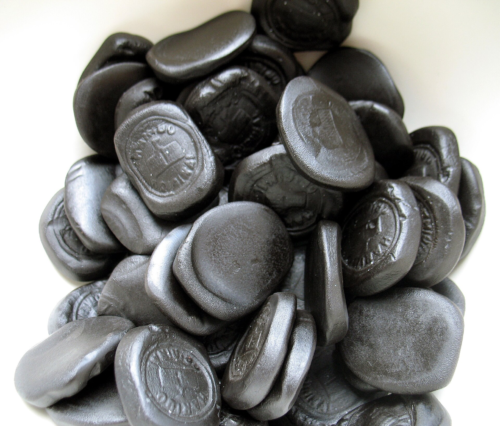
The combination of a binge-watch of “Larkrise to Candleford” and National Candy Day gave rise to today’s rabbit hole adventure. I realize it does not take much to send me diving after those research rabbits, and yes, I also realize I have other more important things to write. And yet, here we are.
You may have seen a small black disc stamped with the image of a castle at a candy store. The humble Pontefract cake in its natural environment. While it does not look especially exciting, the Pontefract cake has a history stretching back hundreds of years, linking medieval monks, apothecaries, castles, and one of England’s most famous confectionery traditions. And into the rabbit hole we go!
From Medicine to Market
The story begins in Pontefract, a market town in West Yorkshire, England. Historians believe monks introduced licorice plants to the area as early as the thirteenth century. The first written records of licorice growing in Pontefract date to the sixteenth century. The plant thrived in the region’s soil, and residents began growing it in small plots known as “garths” behind their homes.
At that time, licorice was not considered candy. It was medicine. People believed it could soothe coughs, ease stomach troubles, and even help horses recover from illness. Apothecaries prepared the root as medicinal lozenges or pastilles that could be dissolved in water.
From Medicine to Confection
Historians credit George Dunhill, a Pontefract apothecary and licorice grower, with the transition from medicine to confection. Around 1760, Dunhill tried adding sugar to medicinal licorice preparations. The result was far more appealing than the original remedy—big surprise, I know! (Sounds just a smidge like the history of chocolate, doesn’t it?)
During the eighteenth century, sugar became more available in Britain, allowing confectioners to create a wider variety of sweets. What had once been a medicinal product evolved into a treat. As demand grew, other manufacturers joined the trade. By the early nineteenth century, firms such as Firth Confectioners were producing sweetened licorice products alongside Dunhill’s business. Pontefract soon became the center of Britain’s licorice industry.
Why Are They Called Cakes?
The name comes partly from their shape and partly from older meanings of the word “cake,” which once referred to many kinds of pressed or molded foods. Originally, they were called “Pomfret cakes,” using an older Norman name for Pontefract. Over time, the modern spelling became standard, and they became known as Pontefract cakes.
One of their most distinctive features is the stamp pressed into the surface. Early cakes were embossed by hand using molds that displayed an image of Pontefract Castle. The castle seal served as a mark of quality and became one of the longest-running trademarks in British confectionery history. Workers known as “cakers” could reportedly stamp tens of thousands of sweets each day before machinery took over the process.
A Victorian Success Story
Pontefract cakes benefited from the changes of industrialization. Improved transportation and manufacturing methods allowed producers to distribute their sweets across Britain. Demand grew so rapidly that local licorice farms could no longer supply enough raw material. Manufacturers imported licorice extract from countries such as Turkey.
By the Victorian era, Pontefract cakes had become one of Britain’s best-known sweets. They appeared in shops across the country and even found their way into literature. Elizabeth Gaskell mentioned “pomfret cakes” in her 1866 novel Wives and Daughters. So I suppose the reference in “From Larkrise to Candleford” should come as no surprise.
While I can recommend the series, I’m not as much a fan of the candy. With all due respect to my licorice-loving friends, I’ll leave the black castle disks to you and stick to chocolate!
References
Wakefield Museums and Castles. 2019. “Pontefract Allsorts: How Liquorice Got Its Roots in Pontefract.” Accessed June 22, 2026. https://museumsandcastles.wakefield.gov.uk/discover/collections/industry/liquorice-and-sweets/how-liquorice-got-its-roots-in-pontefract/
Wakefield Museums and Castles. 2025. “Liquorice Farming.” Accessed June 22, 2026. https://museumsandcastles.wakefield.gov.uk/visit/pontefract-castle/history/liquorice-farming/
Wakefield Museums and Castles. 2026. “Facts About Pontefract.” Accessed June 22, 2026. https://museumsandcastles.wakefield.gov.uk/discover/news-and-blog/pontefract-facts/
Wikipedia Contributors. n.d. “Pontefract Cake.” Wikipedia. Accessed June 22, 2026. https://en.wikipedia.org/wiki/Pontefract_cake
I don’t like liquorice either, but a truly fascinating post. I never heard of the cakes before, nor had them in England—for me Pontefract is the site of a racecourse! I also wondered about the increased availability of sugar—did that have to do with the slave trade? I know abolitionists refused to eat sugar. Research is very addictive