
Churching: The End of Maternity Leave
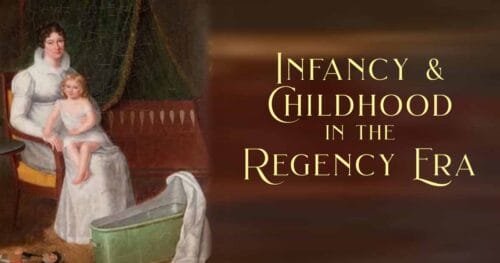
For women in the Georgian and Regency eras, a woman’s confinement officially ended when she had been churched and her child christened. The Church of England offered a special service of thanksgiving called the Churching of Women, included in the Book of Common Prayer. It marked a woman’s recovery and her return to social and religious life. Traditionally, this was the very first place she went after weeks of staying indoors.
Churching emphasized gratitude. A woman thanked God for surviving childbirth and for being restored to health. Yet the ceremony carried older meanings that made it complicated. Its roots lay in the Old Testament, specifically Leviticus 12, which treated childbirth as a state of ritual uncleanness. That history made churching controversial.
Some clergy condemned it as a leftover from Jewish law or as uncomfortably Catholic. Although the Church of England officially removed language about purification in 1552, popular belief did not change overnight. Many people still thought of churching as a form of cleansing, even if the official focus was gratitude rather than impurity. The practice remained widespread, especially in rural areas, where tradition and superstition carried significant influence. Many people believed that a woman who had recently given birth could bring bad luck if she reentered society without some form of ritual acknowledgment.
For the women themselves, churching was often welcome. It was a rare ceremony focused on them, not their husbands or even their babies. It recognized the dangers they had faced and survived. After long weeks of lying-in, it was also their ticket back into the world. Churching marked the end of isolation and the beginning of normal social life. Often, it was followed by a small feast shared with the female friends and relatives—known as gossips—who had supported her through labor.
The Churching Ceremony
The mother stood at the center of the rite, and for generations churching crossed all social boundaries. Poor women and queens alike were expected to take part. The priest officiated, meeting the woman at the entrance of the church and guiding her through the ceremony. A woman’s gossips frequently accompanied her, turning churching into a collective female event rather than a private devotion.
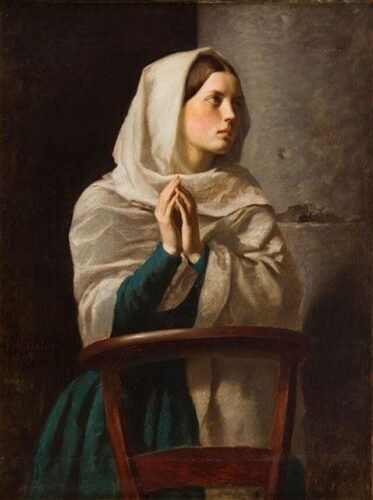
The mother would arrive at church properly dressed, often wearing a white veil. She would kneel at the church door or in the vestibule, sometimes carrying a lighted candle. The priest, wearing a surplice and white stole, sprinkled her with holy water and recited a psalm. He then offered her the end of his stole and led her into the church toward the altar, where the final blessing was given.
The ceremony was brief but meaningful. A small offering or fee, often called churching money, was expected. In poorer communities, this payment could become a source of resentment or political conflict, especially when families were already struggling with the costs of childbirth.
Rules and Exceptions
Churching came with rules, and they were not always kind. Women who had experienced a stillbirth or lost their child shortly after birth were still churched, because the rite focused on the mother’s survival rather than the baby’s fate. Unwed mothers, however, faced harsher treatment. They were often denied churching until they had publicly repented before the congregation.
Even death did not end the controversy. “There are also records of a debate whether a woman who had died in giving birth should be buried in the church graveyard if she had died unchurched. Popular custom occasionally had another woman undergoing the ceremony for the woman who had died, but such practice was not favoured by the church. It was eventually decided that an unchurched woman could be buried, but in a number of cases they were buried in a special part of the graveyard and superstitious beliefs had it that women between 15 and 45 were not supposed to be going to that particular part of the graveyard.” (Knöde, 1995)
Despite its tensions, churching endured. For women across classes, it marked survival, respectability, and the long-awaited moment when confinement ended and life began again.
Read more about Childhood and Infancy during the Regency HERE
References
“Midwifery in Britain: Pre Twentieth Century.” Memories of Nursing. https://memoriesofnursing.uk/articles/midwifery-in-britain-pre-twentieth-century.
Adkins, Roy, and Lesley Adkins. Jane Austen’s England. Viking, 2013.
Boyle, Laura. “Developments in Childbirth in Regency and Victorian England.” Jane Austen Centre Blog, June 20, 2011. https://www.janeausten.co.uk/developments-in-childbirth-in-regency-and-victorian-england/.
Chamberlain, Geoffrey. “British maternal mortality in the 19th and early 20th centuries.” Journal of the Royal Society of Medicine 99, no. 11 (November 2006): 559–563. https://doi.org/10.1258/jrsm.99.11.559
Collins, Irene. Jane Austen and the Clergy. London: Hambledon and London, 2001.
Collins, Irene. Jane Austen, the Parson’s Daughter. London: Hambledon Press, 1998.
Cuff, Mary. “Recovering the Betrothal Ceremony and the Churching of Women.” Crisis Magazine, February 14, 2022. https://www.crisismagazine.com/opinion/recovering-the-betrothal-ceremony-and-the-churching-of-women.
Ezekwem, Ogechukwu. “The Making of Man-Midwifery: Childbirth in England 1660-1770, by Adrian Wilson (1995).” Not Even Past, University of Texas at Austin, October 24, 2012. https://notevenpast.org/the-making-of-man-midwifery-childbirth-in-england-1660-1770-by-adrian-wilson-1995/.
Fitzsimons, Fiona. “The History of Churching of Women.” Irish Family History Centre. https://www.irishfamilyhistorycentre.com/article/the-history-of-churching-of-women/.
Forbes, Thomas R. “The Regulation of English Midwives in the Eighteenth and Nineteenth Centuries.” Medical History 8, no. 3 (1964): 352–362. https://obgynhistory.net/articles/1964-FORBES-RegEng-Rev-Aug2016.pdf.
Fox, Sarah. “Giving Birth in Eighteenth-Century England.” Historical Transactions (blog), Royal Historical Society, April 13, 2022. https://royalhistsoc.org/giving-birth-in-eighteenth-century-england/.
Fox, Sarah. Giving Birth in Eighteenth-Century England. London: University of London Press, 2022. https://uolpress.co.uk/book/giving-birth-in-eighteenth-century-england/ .
Froide, Amy M. “Review of David Cressy’s Birth, Marriage, and Death: Ritual, Religion, and the Life-Cycle in Tudor and Stuart England.” Medieval Feminist Forum 24, no. 1 (1997): 42–45. https://scholarworks.wmich.edu/mff/vol24/iss1/10/.
Indiana University Bloomington. “The Main Bedroom: Confinement.” Wylie House Exhibits. https://exhibits.library.indiana.edu/s/wylie-house-exhibit/page/confinement.
Knödel, Natalie. The Thanksgiving of Women after Childbirth, commonly called The Churching of Women. University of Durham. April 1995 http://users.ox.ac.uk/~mikef/church.html
Kroeger, Catherine. “The Neglected History of Women in the Early Church.” Christian History Magazine, no. 17 (1988). https://www.christianitytoday.com/history/issues/issue-17/neglected-history-of-women-in-early-church.html.
Lamb, Tiphaine. “The Forgotten Tradition of ‘Churching,’ the Ancient Postpartum Blessing.” EWTN Great Britain, February 1, 2025. https://www.ewtn.co.uk/article-the-forgotten-tradition-of-churching-the-ancient-postpartum-blessing/.
Lane, Maggie. Jane Austen’s World: The Life and times of England’s Most Popular Novelist. 2nd ed. London: Carlton Books, 2005.
Lewis, Judith Schneid. In the Family Way: Childbearing in the British Aristocracy, 1760-1860. New Brunswick, N.J.: Rutgers University Press, 1986.
Marland, Hilary. “Victorian Childbirth.” Victorian Web, September 23, 2022. https://victorianweb.org/science/health/pregnancy/childbirth.html.
Martin, Joanna. Wives and Daughters: Women and Children in the Georgian Country House. London: Hambledon and London, 2004.
Morledge, Clarke. “The Churching of Women?” Veracity (blog), January 20, 2018. https://sharedveracity.net/2018/01/20/the-churching-of-women/.
Pope, Charles. “The Churching of Women and its Relation to the Feast of the Presentation.” Community in Mission (blog), February 3, 2019. https://blog.adw.org/2019/02/churching-women-relation-feast-presentation/.
Schulte, Augustin Joseph. “Churching of Women.” In The Catholic Encyclopedia, vol. 3. New York: Robert Appleton Company, 1908. http://www.newadvent.org/cathen/03761a.htm.
Selwyn, David. Jane Austen and Children. New York City: Continuum Books, 2010.
Vickery, Amanda. The Gentleman’s Daughter: Women’s Lives in Georgian England. New Haven, Conn.: Yale University Press, 1998.
Comments
Churching: The End of Maternity Leave — No Comments
HTML tags allowed in your comment: <a href="" title=""> <abbr title=""> <acronym title=""> <b> <blockquote cite=""> <cite> <code> <del datetime=""> <em> <i> <q cite=""> <s> <strike> <strong>