
Recovering from Delivery: Confinments and Lying In

Unlike women today, who often give birth in hospitals or birthing centers, women in the Georgian and Regency periods almost always gave birth at home. There was no standardized medical setting, no neat handoff from pregnancy to delivery to recovery. Instead, childbirth unfolded as a long domestic process, one that reshaped the household for weeks and sometimes months.
Preparation for confinement fell to the expectant mother herself, and among the most important decisions she faced was where she would give birth and recover. That choice shaped not only her comfort, but her safety, her social experience, and the rhythm of the household around her.
Confinement
A woman’s confinement, also known as her lying-in, began when the baby was born and lasted anywhere from a month to six weeks while she recovered.
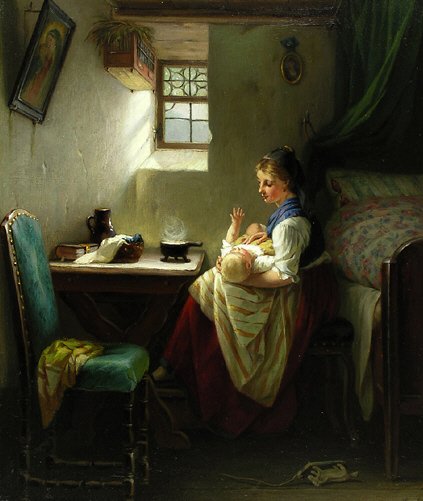
Where a woman chose to give birth was no small matter. Some women returned to their mother’s home for the event, surrounding themselves with familiar female support. Others brought mothers, sisters, or aunts into their own homes. Rooms were often rearranged or redecorated in preparation. Ideally, the lying-in space consisted of two connected rooms. The inner room held the bed itself and was kept dark during labor, delivery, and often for at least the first week afterward. The outer room acted as a sort of waiting area where friends and relatives could gather without disturbing the mother.
For families who could afford it, London was considered the ideal place for a confinement, particularly if the birth of an heir was expected. The city had a reputation for skilled doctors, and that reputation carried weight. Moving to town for a confinement, however, could be extremely disruptive. Even families who already maintained a London house found the logistics exhausting. Since delivery dates could not be predicted accurately, these moves could happen at the last possible moment. Enduring hours in a jolting carriage at the very end of pregnancy, only to face setting up a household, sounds like great fun, doesn’t it?
Once confinement began (that is the baby was born), women were expected to stay indoors and preferably in bed. Medical opinion favored extended rest. Given the real dangers women faced after childbirth, this advice seemed reasonable. Complications such as puerperal fever, hemorrhage, thrombosis, and milk fever were common enough to warrant caution. Most women felt well enough to emerge from confinement after about a month.
Visitors and the Sociable Lying-In Room
During confinement, especially in London, women often received a steady stream of visitors. Friends and relatives came to see the mother and admire the new baby. Many of these women had shared in the drinking of caudle, a hot spiced wine mixture given to ease labor pains, and were known collectively as the mother’s gossips. The lying-in room became a female-dominated social space, full of conversation, food, and shared experience.
Country confinements had their advantages. With fewer people nearby, parents had more control over who visited and when. Even so, the expectation of sociability was strong everywhere.
Medical professionals warned that visitors could spread infection or disturb the mother’s fragile emotional state, but social custom often overruled medical caution. Records show women receiving visitors within days of giving birth, sometimes as early as five days afterward. For visiting unmarried women, these calls served an important purpose. Observing a lying-in allowed them to learn about childbirth and recovery before they experienced it themselves.
The Stages of Recovery
Confinement followed a loose but recognizable pattern, a series of stages rather than a single leap back to normal life over four to six weeks. Women moved from bed to sofa, then into the outer room, and eventually downstairs. Dining with the family marked another step forward, and finally the first venture outside the house.
These milestones were often treated as small social victories. Sitting up in bed, known later as upsitting, and moving from the bed to a chair, sometimes called uprising, were signs that the mother was regaining strength. Visitors took note of these changes and celebrated them with the mother.
Silence, Letters, and Social Duties
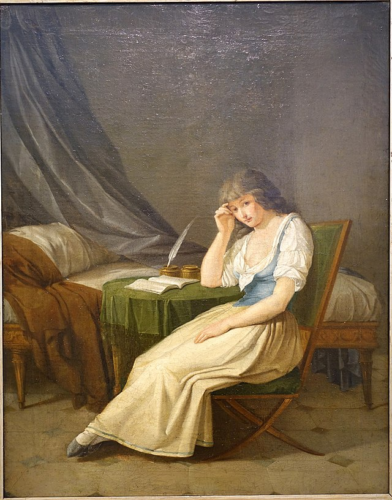
Communication rules shifted during the last weeks of pregnancy and the early days of lying-in. Pregnant women were released from the obligation of answering letters as their due date approached. After delivery, it was customary to wait at least two weeks before resuming correspondence. The first letter written after childbirth signaled that the mother had recovered enough to re-enter her social world.
In wealthy households that could afford the luxury, this process was often controlled by the monthly nurse. These women combined practical medical knowledge with household authority. They cared for the newborn, monitored the mother’s recovery, and often took charge of the household so the mother could remain in bed.
These nurses acted as firm gatekeepers, sometimes forbidding letter-writing or visits if they believed the mother was still too weak. Husbands occasionally found themselves taking up the pen on their wives’ behalf, not out of gallantry, but because the nurse refused to allow the mother to do so.
Class and the Limits of Rest
Social class shaped every aspect of confinement and lying-in. Wealthy and middling women could afford to withdraw from society weeks or even months before birth. Some remained entirely indoors for long stretches, unable or unwilling to venture even into their gardens. After delivery, they enjoyed what was often called a month of privilege, roughly forty days of protected rest supported by servants, relatives, or hired nurses.
Poor and laboring women lived by different rules. For them, confinement began only when labor pains made work impossible. Economic necessity forced many to work until the very last moment. Recovery, too, was often cut short. While even poor women expected some period of lying-in, many returned to work within two weeks. The cost of lying-in itself could be staggering. Extra food, drink, and fuel for fires could place a heavy burden on families with little income.
Privacy also varied by class. In elite households, childbirth took place in a secluded chamber. In crowded, lower-status housing, thin walls meant that labor sounds carried easily. Birth became a more public, communal event, heard and known by neighbors whether the family wished it or not.
Churching and Reintegration
The confinement period formally ended with churching, a religious ceremony of thanksgiving held around forty days after birth. Until this ritual took place, it was socially unacceptable for a woman to leave the house in public. Churching marked the end of separation and the mother’s return to ordinary life.
Stay tuned as we explore the “gander month” next.
Read more about Childhood and Infancy during the Regency HERE
References
“Midwifery in Britain: Pre Twentieth Century.” Memories of Nursing. https://memoriesofnursing.uk/articles/midwifery-in-britain-pre-twentieth-century.
Adkins, Roy, and Lesley Adkins. Jane Austen’s England. Viking, 2013.
Boyle, Laura. “Developments in Childbirth in Regency and Victorian England.” Jane Austen Centre Blog, June 20, 2011. https://www.janeausten.co.uk/developments-in-childbirth-in-regency-and-victorian-england/.
Chamberlain, Geoffrey. “British maternal mortality in the 19th and early 20th centuries.” Journal of the Royal Society of Medicine 99, no. 11 (November 2006): 559–563. https://doi.org/10.1258/jrsm.99.11.559
Collins, Irene. Jane Austen and the Clergy. London: Hambledon and London, 2001.
Collins, Irene. Jane Austen, the Parson’s Daughter. London: Hambledon Press, 1998.
Cuff, Mary. “Recovering the Betrothal Ceremony and the Churching of Women.” Crisis Magazine, February 14, 2022. https://www.crisismagazine.com/opinion/recovering-the-betrothal-ceremony-and-the-churching-of-women.
Ezekwem, Ogechukwu. “The Making of Man-Midwifery: Childbirth in England 1660-1770, by Adrian Wilson (1995).” Not Even Past, University of Texas at Austin, October 24, 2012. https://notevenpast.org/the-making-of-man-midwifery-childbirth-in-england-1660-1770-by-adrian-wilson-1995/.
Fitzsimons, Fiona. “The History of Churching of Women.” Irish Family History Centre. https://www.irishfamilyhistorycentre.com/article/the-history-of-churching-of-women/.
Forbes, Thomas R. “The Regulation of English Midwives in the Eighteenth and Nineteenth Centuries.” Medical History 8, no. 3 (1964): 352–362. https://obgynhistory.net/articles/1964-FORBES-RegEng-Rev-Aug2016.pdf.
Fox, Sarah. “Giving Birth in Eighteenth-Century England.” Historical Transactions (blog), Royal Historical Society, April 13, 2022. https://royalhistsoc.org/giving-birth-in-eighteenth-century-england/.
Fox, Sarah. Giving Birth in Eighteenth-Century England. London: University of London Press, 2022. https://uolpress.co.uk/book/giving-birth-in-eighteenth-century-england/ .
Froide, Amy M. “Review of David Cressy’s Birth, Marriage, and Death: Ritual, Religion, and the Life-Cycle in Tudor and Stuart England.” Medieval Feminist Forum 24, no. 1 (1997): 42–45. https://scholarworks.wmich.edu/mff/vol24/iss1/10/.
Indiana University Bloomington. “The Main Bedroom: Confinement.” Wylie House Exhibits. https://exhibits.library.indiana.edu/s/wylie-house-exhibit/page/confinement.
Knödel, Natalie. The Thanksgiving of Women after Childbirth, commonly called The Churching of Women. University of Durham. April 1995 http://users.ox.ac.uk/~mikef/church.html
Kroeger, Catherine. “The Neglected History of Women in the Early Church.” Christian History Magazine, no. 17 (1988). https://www.christianitytoday.com/history/issues/issue-17/neglected-history-of-women-in-early-church.html.
Lamb, Tiphaine. “The Forgotten Tradition of ‘Churching,’ the Ancient Postpartum Blessing.” EWTN Great Britain, February 1, 2025. https://www.ewtn.co.uk/article-the-forgotten-tradition-of-churching-the-ancient-postpartum-blessing/.
Lane, Maggie. Jane Austen’s World: The Life and times of England’s Most Popular Novelist. 2nd ed. London: Carlton Books, 2005.
Lewis, Judith Schneid. In the Family Way: Childbearing in the British Aristocracy, 1760-1860. New Brunswick, N.J.: Rutgers University Press, 1986.
Marland, Hilary. “Victorian Childbirth.” Victorian Web, September 23, 2022. https://victorianweb.org/science/health/pregnancy/childbirth.html.
Martin, Joanna. Wives and Daughters: Women and Children in the Georgian Country House. London: Hambledon and London, 2004.
Morledge, Clarke. “The Churching of Women?” Veracity (blog), January 20, 2018. https://sharedveracity.net/2018/01/20/the-churching-of-women/.
Pope, Charles. “The Churching of Women and its Relation to the Feast of the Presentation.” Community in Mission (blog), February 3, 2019. https://blog.adw.org/2019/02/churching-women-relation-feast-presentation/.
Schulte, Augustin Joseph. “Churching of Women.” In The Catholic Encyclopedia, vol. 3. New York: Robert Appleton Company, 1908. http://www.newadvent.org/cathen/03761a.htm.
Selwyn, David. Jane Austen and Children. New York City: Continuum Books, 2010.
Vickery, Amanda. The Gentleman’s Daughter: Women’s Lives in Georgian England. New Haven, Conn.: Yale University Press, 1998.
Comments
Recovering from Delivery: Confinments and Lying In — No Comments
HTML tags allowed in your comment: <a href="" title=""> <abbr title=""> <acronym title=""> <b> <blockquote cite=""> <cite> <code> <del datetime=""> <em> <i> <q cite=""> <s> <strike> <strong>