
A Husband’s lot: The Gander Month

If you want a quick way to unsettle a Georgian or Regency husband, take over his bedchamber, fill it with determined women, and inform him—politely—that he is now of no further service. That’s how childbirth might look to a Regency-era husband.
For a culture built on distinct lines of male authority, the weeks surrounding a birth were a startling reversal. The birthing chamber, often home to the marital bed (often described as the heart of patriarchy) became something else. It turned into a “gossips’ parlor”, run by women, loud with opinions, and closed to men.
Many husbands resented this shift for practical reasons as much as emotional ones. They lost access to space they considered their own. They lost authority over decisions. They lost the comforting illusion that they were in charge of everything under their roof. Once labor began, men were ushered out, told they could do nothing useful, and left to pace elsewhere while a female collective took over.
Midwives and the mother’s gossips—female friends and family—were assertive and alert, and often prepared to challenge any man, including trained medical professionals, who overstepped. To some men, this gathering could feel less like support and more like an invasion. Complaints about drunken women show up often in period records, though whether that reflects actual behavior or bruised pride is open to interpretation.
How Men Spent the Gander Month
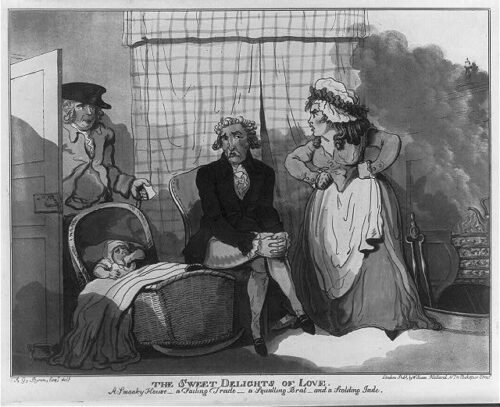
The gander month was the four to six-week period after birth while a woman recovered before her churching ceremony marked her return to public life. While women dominated the birthing room, the gander month rearranged the rest of the household, placing new burdens on the husband.
Men were expected to manage domestic affairs that their wives usually handled. They dealt with older children, kept the household running, and worried about money. Many also complained about the cost of feeding the women attending the birth, an expense that felt unfair when paired with their newfound workload.
Economic and Domestic Burden on Husbands
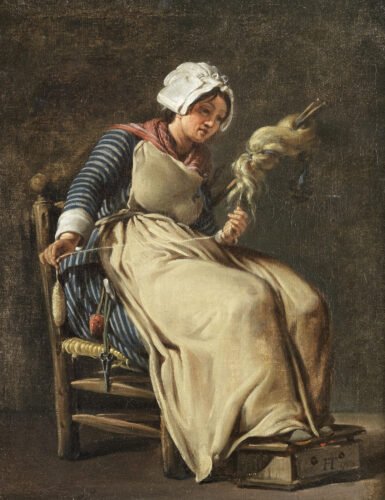
For laboring families, the gander month was not just inconvenient. It was burdensome. In artisanal, agricultural, and wage-laboring households, the father became the sole income earner while also acting as primary caregiver. Wealthy families could hire monthly nurses or servants. Poor families could not. Mothers, aunts, and sisters might be called upon, but there was no guarantee they would be available.
Even if there was extra help to be had, costs accumulated during a mother’s recovery. Food, drink, and extra fuel for fires could add up to serious sums compared to a laborer’s wage. Period sources record male resentment that reflects this pressure as much as any fear of female power. Lower-income women often returned to work after two weeks or less because of the economic realities their families faced.
One can only imagine how much the family might look forward to a woman’s churching, the final step in her lying-in, that marked the return to normal family order.
Next time we’ll take a look at the churching ceremony.
Read more about Childhood and Infancy during the Regency HERE
References
“Midwifery in Britain: Pre Twentieth Century.” Memories of Nursing. https://memoriesofnursing.uk/articles/midwifery-in-britain-pre-twentieth-century.
Adkins, Roy, and Lesley Adkins. Jane Austen’s England. Viking, 2013.
Boyle, Laura. “Developments in Childbirth in Regency and Victorian England.” Jane Austen Centre Blog, June 20, 2011. https://www.janeausten.co.uk/developments-in-childbirth-in-regency-and-victorian-england/.
Chamberlain, Geoffrey. “British maternal mortality in the 19th and early 20th centuries.” Journal of the Royal Society of Medicine 99, no. 11 (November 2006): 559–563. https://doi.org/10.1258/jrsm.99.11.559
Collins, Irene. Jane Austen and the Clergy. London: Hambledon and London, 2001.
Collins, Irene. Jane Austen, the Parson’s Daughter. London: Hambledon Press, 1998.
Cuff, Mary. “Recovering the Betrothal Ceremony and the Churching of Women.” Crisis Magazine, February 14, 2022. https://www.crisismagazine.com/opinion/recovering-the-betrothal-ceremony-and-the-churching-of-women.
Ezekwem, Ogechukwu. “The Making of Man-Midwifery: Childbirth in England 1660-1770, by Adrian Wilson (1995).” Not Even Past, University of Texas at Austin, October 24, 2012. https://notevenpast.org/the-making-of-man-midwifery-childbirth-in-england-1660-1770-by-adrian-wilson-1995/.
Fitzsimons, Fiona. “The History of Churching of Women.” Irish Family History Centre. https://www.irishfamilyhistorycentre.com/article/the-history-of-churching-of-women/.
Forbes, Thomas R. “The Regulation of English Midwives in the Eighteenth and Nineteenth Centuries.” Medical History 8, no. 3 (1964): 352–362. https://obgynhistory.net/articles/1964-FORBES-RegEng-Rev-Aug2016.pdf.
Fox, Sarah. “Giving Birth in Eighteenth-Century England.” Historical Transactions (blog), Royal Historical Society, April 13, 2022. https://royalhistsoc.org/giving-birth-in-eighteenth-century-england/.
Fox, Sarah. Giving Birth in Eighteenth-Century England. London: University of London Press, 2022. https://uolpress.co.uk/book/giving-birth-in-eighteenth-century-england/ .
Froide, Amy M. “Review of David Cressy’s Birth, Marriage, and Death: Ritual, Religion, and the Life-Cycle in Tudor and Stuart England.” Medieval Feminist Forum 24, no. 1 (1997): 42–45. https://scholarworks.wmich.edu/mff/vol24/iss1/10/.
Indiana University Bloomington. “The Main Bedroom: Confinement.” Wylie House Exhibits. https://exhibits.library.indiana.edu/s/wylie-house-exhibit/page/confinement.
Knödel, Natalie. The Thanksgiving of Women after Childbirth, commonly called The Churching of Women. University of Durham. April 1995 http://users.ox.ac.uk/~mikef/church.html
Kroeger, Catherine. “The Neglected History of Women in the Early Church.” Christian History Magazine, no. 17 (1988). https://www.christianitytoday.com/history/issues/issue-17/neglected-history-of-women-in-early-church.html.
Lamb, Tiphaine. “The Forgotten Tradition of ‘Churching,’ the Ancient Postpartum Blessing.” EWTN Great Britain, February 1, 2025. https://www.ewtn.co.uk/article-the-forgotten-tradition-of-churching-the-ancient-postpartum-blessing/.
Lane, Maggie. Jane Austen’s World: The Life and times of England’s Most Popular Novelist. 2nd ed. London: Carlton Books, 2005.
Lewis, Judith Schneid. In the Family Way: Childbearing in the British Aristocracy, 1760-1860. New Brunswick, N.J.: Rutgers University Press, 1986.
Marland, Hilary. “Victorian Childbirth.” Victorian Web, September 23, 2022. https://victorianweb.org/science/health/pregnancy/childbirth.html.
Martin, Joanna. Wives and Daughters: Women and Children in the Georgian Country House. London: Hambledon and London, 2004.
Morledge, Clarke. “The Churching of Women?” Veracity (blog), January 20, 2018. https://sharedveracity.net/2018/01/20/the-churching-of-women/.
Pope, Charles. “The Churching of Women and its Relation to the Feast of the Presentation.” Community in Mission (blog), February 3, 2019. https://blog.adw.org/2019/02/churching-women-relation-feast-presentation/.
Schulte, Augustin Joseph. “Churching of Women.” In The Catholic Encyclopedia, vol. 3. New York: Robert Appleton Company, 1908. http://www.newadvent.org/cathen/03761a.htm.
Selwyn, David. Jane Austen and Children. New York City: Continuum Books, 2010.
Vickery, Amanda. The Gentleman’s Daughter: Women’s Lives in Georgian England. New Haven, Conn.: Yale University Press, 1998.
Comments
A Husband’s lot: The Gander Month — No Comments
HTML tags allowed in your comment: <a href="" title=""> <abbr title=""> <acronym title=""> <b> <blockquote cite=""> <cite> <code> <del datetime=""> <em> <i> <q cite=""> <s> <strike> <strong>