
Special Days of the Holiday Season
Explore the traditions the Darcys enjoy in the Darcys’ First Christmas.
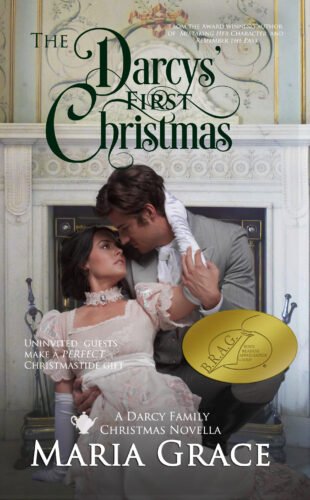
Regency Era holiday celebrations and traditions extended from a week before Advent all the way through to Twelfth Night in January. During the entire season people held a wide variety of festivities including balls, parties, dinners, house parties and visits, skating and card parties as well as smaller gatherings and even weddings.
Stir it up Sunday

The season unofficially started with Stir it up Sunday, which took place on the Sunday before the beginning of Advent (the fourth Sunday before Christmas.) On this day, the family would gather to make Christmas puddings which needed to age before they were served, flaming, at Christmas dinner. The day became known as “Stir Up Sunday,” not because of the great deal of stirring done, but because the opening words of the main prayer in the Book of Common Prayer of 1549 for that day are: ‘Stir up, we beseech thee, O Lord, the wills of thy faithful people…’
December 6th : St. Nicholas Day
In a tradition from Northern Europe, the day might be celebrated with the exchanging of small gifts particularly for children. Not everyone participated in this tradition. This was also the traditional for Christmastide visiting to begin.
December 21st: St. Thomas Day
St Thomas’ Day was a day for elderly women (often widows) to go ‘a’thomasing’ at the houses of their more fortunate neighbors hoping for gifts of food or money. Oftentimes, wheat was cooked and distributed to the ‘mumpers’ who came begging.
With the high price of wheat, the gifts was specially appreciated gift. This practice had become especially common during the early 1800’s. The Napoleonic wars may have contributed to the practice by dramatically increasing the number of widows.
December 24th: Christmas Eve

On Christmas Eve, the decorations and greenery were put up throughout the house. Traditional greenery included holly, ivy, rosemary, evergreen, hawthorn, bay leaf, laurel, and hellebore (Christmas rose). Some households fashioned kissing boughs from evergreens and mistletoe, adding apples and pretty ribbon bows for decoration. The greenery remained in place until Epiphany when they were removed and burned lest they bring bad luck to the house.
December 25th: Christmas day
Christmas Day usually began with a trip to church. Though gifts were not typically exchanged on this day, small gifts might be given to children. Cottagers would sometimes gave generous landowners a symbolic gift for Christmas Day as well.
Christmas Dinner was a feast to be anticipated. It often opened with a toast that included the servants who received their Christmas gifts at this time.
Boar’s head, roasted or brawn—a kind of potted meat dish—often took center stage. Roast goose was another Christmas dinner favorite. The size of the bird often required it be cooked by a baker with a large oven and picked up on the way home from church.
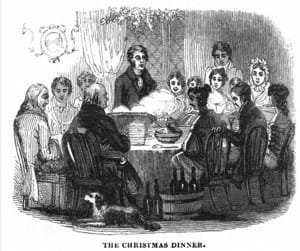
Many also considered mince meat pies, also known as Christmas or Twelfth Night pies, staples for a Christmas feast. The pies contained chopped meat, dried fruit, spices and sugar. Leftovers from the Christmas feast would be used to make pies for the twelve days until Epiphany. Eating minced pie every day of the twelve days of Christmas was said to bring twelve months of happiness in the new year.
At the end of the meal, the Christmas puddings made a month earlier would make their appearance. When the pudding was served, a sprig of holly was placed on the top of the pudding as a reminder of Jesus’ Crown of Thorns that he wore when he was killed. The pudding would be doused with brandy and set aflame, a key theatrical aspect of the holiday celebration.
December 26th: St. Stephen’s Day or Boxing Day
Giving ‘Christmas Boxes’ to charity and servants was the custom on St. Stephen’s Day, now called Boxing Day. Old clothing and extra items were boxed up and handed out to servants and tradesmen who visited that day, and servants were often given the day off. Boxing Day was also a traditional day for fox hunting. Theaters also opened their Christmas Pantomimes on Boxing Day.
December 31: New Year’s Eve
A number of traditions formed around New Year’s eve and New Year’s day. Not all were practiced by everyone, and some varied by county. Some celebrated with the family or their party gathering in a circle before midnight. At the stroke of the midnight hour, the head of the family would open the door and usher out the old and welcome the new. Some who held to old superstitions would remove ashes, rags, scraps and anything perishable from the house so that nothing was carried over from one year to the next. In this way, they would preserve their good luck and banish any poor luck.

Some Scots and folks of northern England believed in ‘first footing’—the nature of the first visitor to set foot across the threshold after midnight on New Year’s eve affected the family’s fortunes.
A tall, dark, and handsome male stranger was the best omen, especially if his feet were the right shape. High-insteps implied that “water would run under”—that is bad luck would flow past. A flat foot meant bad luck, as did women in most cases.
These omens were not fully agreed upon as for some blonde or red-headed, bare-foot girls were bringers of good luck. Whoever was the first-footer, they had to be greeted with proper ceremony and a rhyme to welcome the New Year and bring good fortune.
The “first footer” entered through the front door. Tradition held that no one spoke until the ‘first-footer’ wished the occupants a happy new year. The first-footer would leave through the back door and take all the old year’s troubles and sorrows.
January 1: New Year’s Day
New Year’s Day was considered a predictor of good fortune for the next year. One custom was to hook a flat cake on the horns of a cow. If the cake fell off in front of the cow, it foretold good luck; if behind, bad.
In some regions, young women raced to draw the first water from the well in a practice known as ‘creaming the well.’ Possession of this water meant marriage within the coming year, particularly if the object of the young woman’s affections drank it on New Year’s Day. Some believed the water had curative properties and even washed the udders of cows with it to insure productivity.In Hertfordshire, at sunrise on New Year’s Day, a hawthorn bush would be burned in the fields to ensure good luck and bountiful crops.
January 6th: Twelfth Night
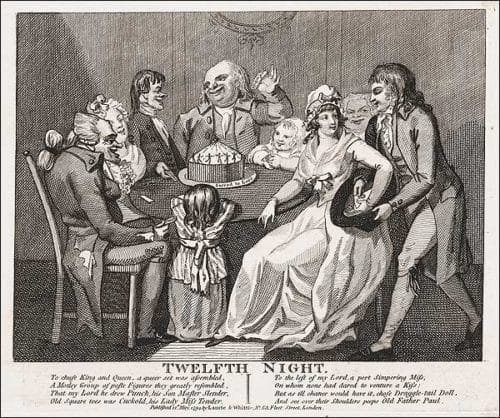
Epiphany or Twelfth Night was the exciting climax of the Christmastide season, a time for putting away social norms. It was a feast day to mark the coming of the Magi, and as such was the traditional day to exchange gifts. Decorations were to be taken down and burned by midnight on this day or face bad luck for the rest of the year. Some believed that for every branch that remained a goblin would appear.
Revels, masks and balls were the order of the day and night. Elaborate and expensive Twelfth day cakes covered with colored sugar and pastillage figures were served amid the parlor games and dancing, sometimes with very rowdy celebrations.
Sadly, the celebrations became so riotous that in the 1870′s, Queen Victoria outlawed the celebration of Twelfth Night in fear the celebrations had become out of control.
Read about Darcy’s experience at a Twelfth Night Ball here.
References
A Regency Christmas. Kieran Hazzard. 2013 2nd Bn. 95th Rifles
A Regency Primer on Christmastide & New Year’s. Kristen Koster. 2011.
Boxing Day. Jane Austen’s World. 2006
Celebrating the New Year. Johanna Waugh. 2008
Christmas, Regency Style. Regina Scott.
Christmas Traditions in Regency England. Regan Walker
Comments
Special Days of the Holiday Season — No Comments
HTML tags allowed in your comment: <a href="" title=""> <abbr title=""> <acronym title=""> <b> <blockquote cite=""> <cite> <code> <del datetime=""> <em> <i> <q cite=""> <s> <strike> <strong>