
Engineering Genius of the Early 1800s
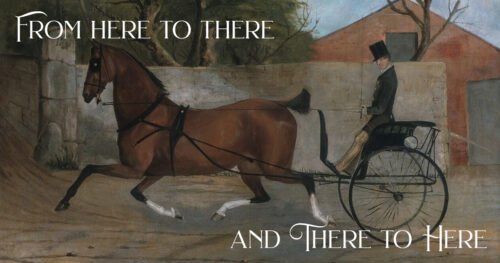
When we imagine Regency transportation, horses and carriages come to mind, not engineering. But Regency era carriages boasted some of the most sophisticated transportation technology of the day. Engineers and coachbuilders wrestled with many of the same problems automakers face today: speed, passenger comfort, steering, suspension, cargo capacity, and vehicle stability.
Better Roads Changed Everything
It all started with the roads. For centuries, Britain’s roads were often muddy, rutted, and poorly maintained. A carriage journey could leave both passengers and vehicles battered by the time they reached their destination.
Scottish engineer John Loudon McAdam developed a new method of road construction using layered crushed stone to create a hard, durable surface. These new “macadamized” roads also drained water effectively.
The impact was dramatic. Carriages traveled faster because their wheels encountered less resistance. Journeys that once took days became significantly shorter. Average travel speeds increased enough that people rethought what a carriage should be.
The old, heavy coaches had been built to survive terrible roads. Now that roads were improving, travelers wanted something different. They wanted speed.
A Lighter Carriage for a Faster World
As roads improved, coachbuilders began redesigning nearly every part of the carriage.
Earlier vehicles often relied on a large central beam called a perch. This beam connected the front and rear axles and acted like the spine of the carriage. While strong, it added considerable weight.
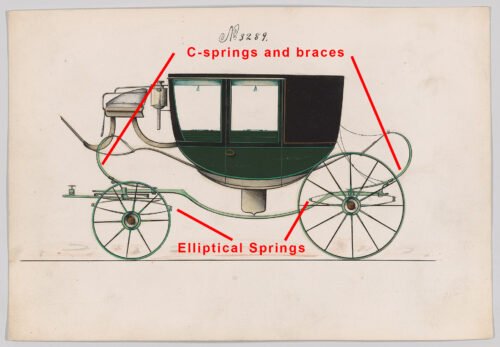
Some designs, such as crane-neck and swan-perch carriages, required additional iron reinforcements to function. The result was a sturdy vehicle, not a nimble one.
In 1804, coachbuilder Obadiah Elliott introduced the elliptic spring that transformed carriage design. Instead of suspending the carriage body from leather straps and a complicated framework, Elliott mounted the body directly on springs attached to the axles, allowing builders to eliminate the heavy perch.
The result was a lighter carriage that could travel faster while giving passengers a smoother ride. Who wouldn’t love that?
Comfort on Rough Roads
Nutcracker springs was a common Regency-era term for elliptical springs. They were made of two sets of overlapping steel plates, or “leaves,” bolted together to form an elliptical or semi-elliptical shape. This design allowed the spring to compress and rebound, acting as a shock absorber for the vehicle.
These springs made the ride much smoother and the vehicle more stable than previous suspension systems, such as the older C-springs. Because the vehicles were lighter, they were easier for animals to pull. For example, the barouchet (a smaller version of the barouche) was often built on nutcracker springs specifically so it could be light enough to be drawn by a single horse.
While these springs made travel more efficient, they were used on lighter pleasure vehicles rather than the massive, heavy-duty traveling coaches which required heavy C-springs. C-springs were often combined with leather braces. Together they created a gentle swaying motion that helped reduce the impacts of travel.
At least that was the goal. In practice, motion sickness was common. Even brief trips could still leave passengers sore, tired, and ready to walk simply for the pleasure of standing upright.
Engineering a Better Ride
As travel speeds increased, carriage designers faced another challenge.
Large wheels had been essential for managing uneven road surfaces. In 1820, Samuel Hobson introduced smaller wheel designs. Interesting side effect: this reduced the center of gravity and made carriages less likely to overturn.
That may sound like a minor improvement, but it solved a growing problem.
Regency travelers carried a surprising amount of luggage. Families heading to London for the Season often traveled with trunks, hat boxes, dress cases, and enough belongings to furnish a small apartment. Much of that baggage rode on top of the carriage.
The higher the load, the greater the risk of tipping. Lowering the carriage body helped compensate for all that rooftop weight.
The Steering Problem
Anyone who has ever backed a trailer into a parking space understands that turning can be … tricky … let’s go with that description.
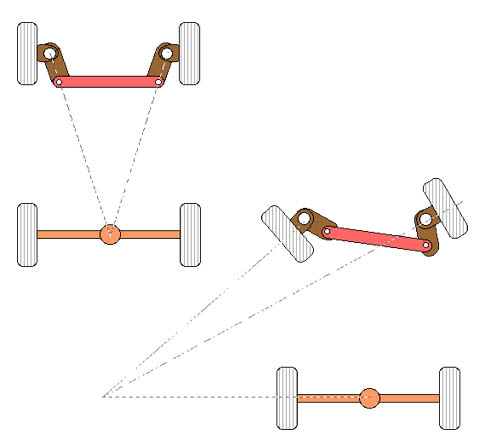
Four-wheeled vehicles were stable, but difficult to maneuver through narrow streets or around sharp corners, common features in bustling cities. In 1819, Rudolph Ackermann (yes, the same one of Ackermann’s Repository of Arts fame) promoted a new steering system that allowed the front wheels to turn more effectively during corners.
Rather than forcing both wheels to follow the same path, Ackermann’s design allowed them to move in a way that better matched the geometry of the turn. It allowed the front inside wheel to turn at a tighter angle than the outside wheel, allowing both to roll without slipping sideways during a tight turn. And here we thought Ackermann was all about the fashion plates!
Storage was part of the Design
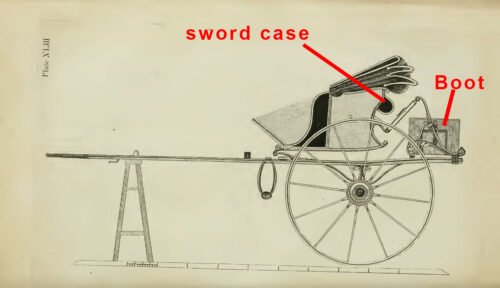
Body: a chair back with sham doors and sword case lined with second cloth trimmed with 2½ inch lace, a sliding seat-box and a carpet. A round fixed head and a knee-boot of small size, a small platform budget.. Public Dmain
Modern drivers often judge a vehicle by the number of cup holders it contains. Regency travelers had their own storage concerns, which designers sought to address.
The boot served much the same purpose as a modern trunk. However, where that storage space was placed mattered. Weight had to be distributed carefully to keep the carriage balanced.
Even the rumble seat often served more than one purpose. Located at the rear of many carriages, it provided seating for a groom or servant. At the same time, the weight of that passenger could help balance the vehicle and improve handling.
Two Wheels or Four?
One of the most important choices facing Regency travelers was whether to ride in a two-wheeled or four-wheeled vehicle.
The debate was not unlike choosing between a sports car and a family SUV or minivan today.
Two-wheeled vehicles like gigs and curricles were lighter and faster. They responded quickly and offered a more exciting driving experience. Young gentlemen especially favored them because they showcased both horsemanship and style.
The trade-off was stability. A two-wheeled vehicle depended on the horses for balance. If a horse stumbled or became difficult to control, the entire carriage could become unstable in seconds. The curricle added another layer of complexity because it was pulled by a pair of horses, the only two-wheeled vehicle with two horsepower. Special harness arrangements distributed the weight and avoided overburdening the animals. Driving one successfully required genuine skill.
The second axle in four-wheeled carriages provided greater stability and allowed for more sophisticated suspension systems. Passengers generally enjoyed a smoother, safer ride, and a stumble by one horse was less likely to send everyone tumbling into the road.
Today it is easy to look at a Regency carriage and see little more than an attractive antique or a primitive means of travel. But in their day, these vehicles represented the cutting edge of transportation technology, much the way early model cars and trains demonstrate revolutions in vehicle design in the 19th and 20th centuries.
What surprised you most? For me it was learning about Ackermann’s contribution to modern transportation. What about you? Tell me in the comments.
Read more about transportation during the Regency Era here.
References
The reference section for this series is VERY long, so you can find it HERE.
Comments
Engineering Genius of the Early 1800s — No Comments
HTML tags allowed in your comment: <a href="" title=""> <abbr title=""> <acronym title=""> <b> <blockquote cite=""> <cite> <code> <del datetime=""> <em> <i> <q cite=""> <s> <strike> <strong>