
A Vicar’s Side Hustle: Boys’ schools
A certain vicar we know is starting a school and needs a little help in A Most Affectionate Mother.
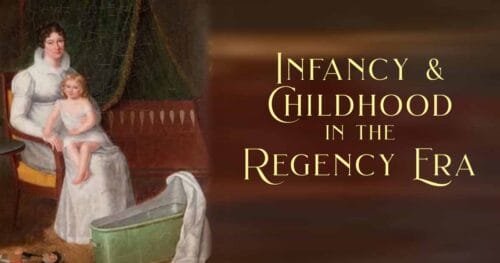
While we usually think of the Regency Era vicar doing the work of the church, preaching or visiting sick neighbors in a small village. However, many vicars were poorly paid and needed to earn extra money to support their own children and maintain a comfortable lifestyle in a manner befitting their station.
They were often the headmasters of small, private boarding schools held in their own homes. By taking in the sons of local gentlemen, they could turn their parsonage into a classroom and their dining table into a school hall. These were not the massive, massive like Eton or Harrow. Instead, these were cozy, sometimes crowded, and very personal “home schools” where a handful of boys lived and learned under the same roof as the vicar’s family.
The Financial Realities of the Clergy
In the early 1800s, the income of a vicar or rector could vary wildly. Some had very wealthy parishes, but many others struggled to get by on a small living. This yearly stipend was supposed to let the priest concentrate on his church duties without needing a secular job, but the math rarely added up.
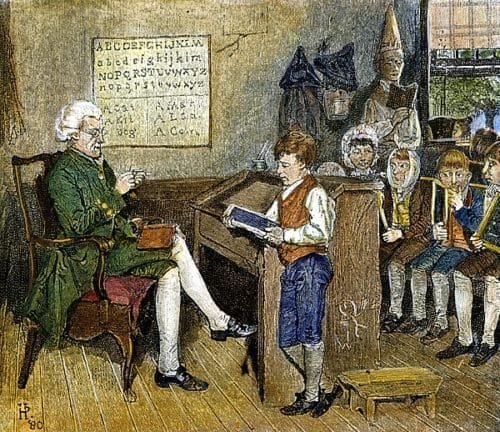
George Austen, the father of Jane Austen, earned about two hundred and thirty pounds a year from his church work, but by teaching the sons of gentlemen, he could significantly boost that income. This extra money helped pay for his own daughters to attend school and kept his household running smoothly. (Walker (2005) suggests Jane and her sister Cassandra were sent away to school to make room for more students who, even after the girl’s school fees were paid, would increase the family’s income. But that’s a discussion for a different day.)
How Students Found Their Way to the Vicarage
Vicars relied on their social networks and local reputations to bring in their students. Most students were the sons of local gentlemen, landowners, or other clergy members who knew the vicar through social dining clubs or church meetings. If a vicar had a reputation for being an excellent scholar or a kind man, parents would flock to him. Some vicars would also put up a simple sign announcing a school on or near their home to let passersby know they were open for business.
What the Boys Learned
The curriculum in a vicar’s school was very specific. After a boy had a basic grasp of reading and writing (penmanship), the focus shifted to classical scholarship. This meant hours and hours of studying Greek and Latin. These “dead languages” were considered the hallmark of a true gentleman. Boys would repeat Latin nouns over and over until they knew them by heart. French was often taught, as well. Students also studied history, geography, and arithmetic. Even though many of these boys would one day run estates or businesses, land management or bookkeeping were seen as “trade” and usually left for the sons of merchants to learn.
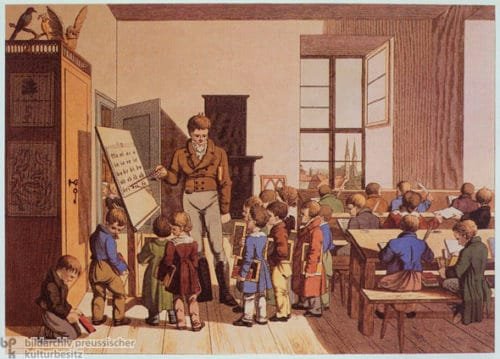
The purpose of this classically focussed education was to prepare students for the next big steps: attending a major public school like Eton or universities like Oxford and Cambridge. It also offered social training. The vicar’s wife played a major, if unofficial, role in the boys’ education, acting as a surrogate mother, teaching them how to behave in polite society.
The Cost of a Vicarage Education
Sending a boy to a vicarage school was a significant expense for a family. On average, a family could expect to pay between thirty and fifty pounds a year for their son to be a boarder. This fee usually covered his room, his meals, and his lessons.
There were also extra costs to consider. If a boy wanted to be a parlor boarder, which meant enjoying the privilege of eating with the vicar’s family and using the better rooms in the house, his parents paid even more. Some subjects, like dancing or music, might require hiring an outside master, which also added to the bill.
Even though these boys were from wealthy families, they often lived and ate simply. It was common for students to drink only water (as opposed to wine) at dinner to keep costs down and stay focused on their studies.
A Lasting Legacy of Learning
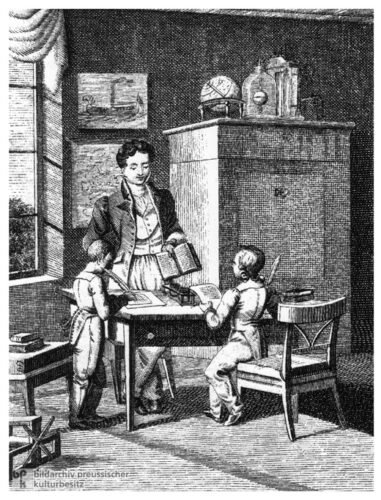
Original: Staatliche Museen zu Berlin – Preußischer Kulturbesitz, Kunstbibliothek / Lipp Dd 5
Standort bitte unbedingt angeben!;
While these small parsonage schools might seem informal, they were the backbone of education for the upper and middle classes during the Regency era. They provided a safe, local option for parents who weren’t quite ready to send their ten-year-old boys off to a distant, giant boarding school. For the vicars, it was a way to stay out of debt and provide for their families. For the boys, it was a place to learn the languages and manners that would define them as gentlemen for the rest of their lives.
Learn more about Regency era childhood here
Learn more about Regency era education.
Learn more about Regency era clergy here.
References
“Fortunes of the Clergy.” St. George-in-the-East Church. Accessed August 16, 2026. https://stgitehistory.org.uk/media/stipends.html .
“The Education of Boys in Regency England.” Story and History. October 5,2015. https://storyandhistory.com/2015/10/05/the-education-of-boys-in-regency-england/
Austen-Leigh, James Edward. 1871. A Memoir of Jane Austen. London: Richard Bentley and Son.
Gillard, Derek. “Education in the UK: a history.” Education in the UK. 2018 https://education-uk.org/history/chapter05.html
Le Faye, Deirdre. 2002. Jane Austen: The World of Her Novels. New York: Harry N. Abrams.
Moritz, Karl Philipp. 1782. Travels in England in 1782. English translation republished by Mobipocket.
Sanborn, Vic. “19th Century Learning Academies and Boarding Schools: An Eyewitness Account.” Jane Austen’s World. August 1, 2012. https://janeaustensworld.com/2012/08/01/19th-century-learning-academies-and-boarding-schools-an-eyewitness-account/ .
Walker, Linda Robinson. “Why was Jane Austen Sent away to School at Seven?” Persuasions On Line Vol 26, No. 1. 2005. JASNA. https://www.jasna.org/persuasions/on-line/vol26no1/walker.htm
Comments
A Vicar’s Side Hustle: Boys’ schools — No Comments
HTML tags allowed in your comment: <a href="" title=""> <abbr title=""> <acronym title=""> <b> <blockquote cite=""> <cite> <code> <del datetime=""> <em> <i> <q cite=""> <s> <strike> <strong>