
Bath Chairs: Changing Mobliity Forever

If you wandered through the elegant streets of Georgian Bath, you would have seen something curious rolling past the Pump Room. It looked a cross between a tiny carriage and a comfortable chair, a practical solution to a very human problem: how to move comfortably through a world that was not built for ease of mobility. The Bath chair began as a response to inconvenience, but it became something far more important. Its story is not just one of mechanical innovation, but of how people thought about illness, independence, dignity, and even status.
Bath Needed a Better Way to Move About
Eighteenth-century cities were not designed for ease of movement. Streets were narrow, crowded, and often filthy. Walking was often unsafe, especially for someone recovering from illness or struggling with limited mobility.
Bath, famous for its healing mineral waters, attracted visitors from across Britain. Many sought relief from chronic pain, injury, or long-term illness. These visitors also wanted to participate in active social life Bath offered: attending concerts; visiting the Pump Room; taking the air along the fashionable promenades.
Before the Bath chair, many relied on the sedan chair. This was an enclosed seat carried by two men using long poles. The sedan chair provided privacy and protection from the mud, but it required constant physical labor from attendants and was expensive to maintain. Over time, people began looking for something more efficient.
Enter James Heath
Around 1750, an inventor named James Heath developed what became known as the Bath chair. His idea was simple but transformative. Instead of carrying the passenger on poles, they could ride in a chair on wheels.
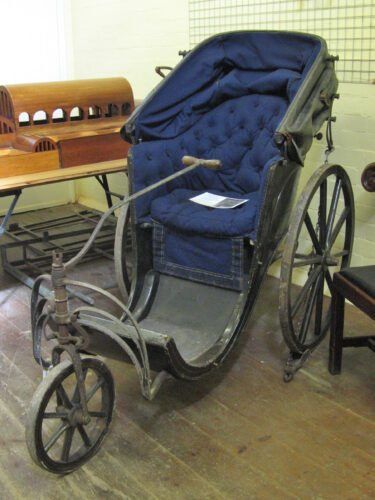
The early Bath chair usually had two large wheels connected by an axle beneath the seat and a smaller wheel in front. An attendant pushed from behind while the passenger could steer using a curved handle connected to the front wheel. This meant the traveler was no longer simply cargo. The passenger now had some control over direction and movement; mobility could belong partly to the user.
John Dawson later refined the design in 1783, improving comfort and maneuverability. His version proved so practical that it remained popular for decades.
Engineering Meets Comfort
The Bath chair balanced practicality with comfort. Frames were often made of wood or iron, while seats were upholstered for long outings. Many models included folding leather hoods to protect passengers from rain or wind. Some used suspension springs to soften the bumps of uneven streets.
Designers paid attention to both function and appearance. A well-made chair might feature painted panels, padded armrests, or fine cloth linings. These were not crude medical devices. They were carefully crafted objects intended to blend into polite society.
Some chairs could even be adapted to be pulled by a small pony or donkey, extending their usefulness for longer journeys.
To See and be Seen
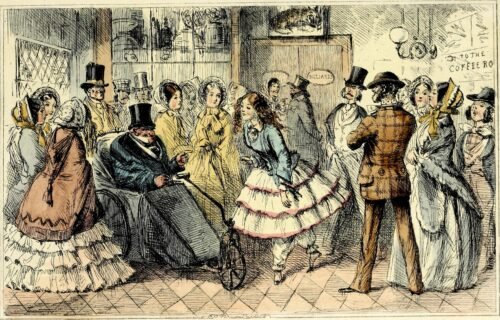
Spa towns valued appearance. Visitors did not merely seek healing; they also sought to see and be seen. The Bath chair allowed participation without strain. It allowed someone to join the promenade without the exhaustion of walking long distances. Wealthy visitors often used them simply to conserve energy or maintain decorum while appearing in public spaces.
Since the Bath chair required only one attendant instead of two chairmen, it was less expensive than the sedan chair, which only enhanced its popularity. Over time, wheeled chairs became a common sight in Bath and other resort towns such as Buxton and Tunbridge Wells. By the mid-nineteenth century, the Bath chair had largely superseded the sedan chair as a preferred form of short-distance transport.
The Bath Chair and the Idea of Independence
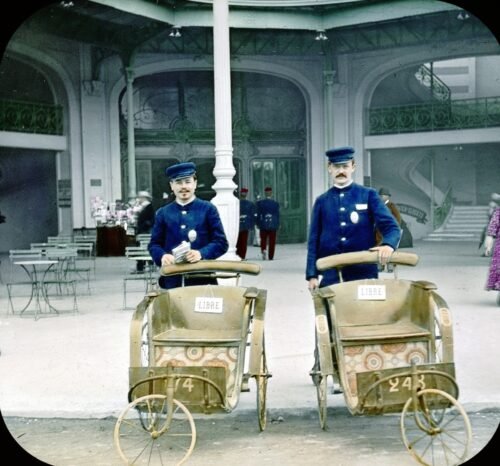
One of the most important features of the Bath chair was the steering tiller. With this simple mechanism, the passenger could guide direction rather than relying entirely on an attendant.
That shift reflects a larger cultural change. Earlier forms of transport emphasized dependence on servants. The Bath chair introduced the idea that mobility could involve cooperation rather than complete reliance. Later mobility devices would continue this trend, eventually leading to self-propelled wheelchairs and lightweight folding designs.
The Bath chair stands at an important turning point in that story. It bridged the gap between being carried and moving with some degree of personal control.
Today, the Bath chair might seem quaint, even decorative. Yet in its own time, it represented innovation shaped by real human needs, making movement easier with less reliance on heavy labor. People could remain part of society even when physical strength failed.
What do you think? Tell me in the comments.
Read more about Sedan chairs, Bath Chairs, and other modes of transportation here.
References
Carriage Foundation. “Bath Chair.” Carriages of Britain. 2026.. https://www.thecarriagefoundation.org.uk/item/bath-chair-1
Carriage Foundation. “Invalid Carriage.” Carriages of Britain. https://www.thecarriagefoundation.org.uk/item/invalid-carriage-bristol
Davidson, Lucy. “When Was the Wheelchair Invented?” History Hit. April 14, 2022. https://www.historyhit.com/when-was-the-wheelchair-invented/
Doe & Hope. “A Wonderful Mid 19thC Invalid Carriage / Bath Chair c.1854.” Doe & Hope. Accessed February 26, 2026. https://www.doeandhope.com/en-us/products/a-wonderful-mid-19thc-invalid-carriage-bath-chair-c-1854
Fawcett, Trevor. “Chair Transport in Bath: The Sedan Era.” Bath History. https://historyofbath.org/images/BathHistory/Vol%2002%20-%2005.%20Fawcett%20-%20Chair%20Transport%20in%20Bath%20-%20The%20Sedan%20Era.pdf
Living Made Easy. “UK Disability History Month: The History of the Wheelchair.” Living Made Easy. 2026. https://livingmadeeasy.org.uk/advice-articles/history-of-the-wheelchair
Love, Suzi. “18th-19th Century Sedan Chair Travel In Jane Austen’s Times.” Suzi Love (blog). May 25, 2024. https://www.suzilove.com/?p=19067
Museum of Bath at Work. “Bath Chair – Museum of Bath at Work.” BBC – A History of the World. 2014. https://www.bbc.co.uk/ahistoryoftheworld/objects/popk2AxUQ5iEpgTQqnPiiQ
National Trust Collections. “Bath Chair, late nineteenth century.” Accessed March 23, 2026. https://www.nationaltrustcollections.org.uk/object/10542 (nationaltrustcollections.org.uk)
Tenby Museum. “Victorian Bath Chair.” BBC – A History of the World. 2014. https://www.bbc.co.uk/ahistoryoftheworld/objects/5Wfs5HOZSaOexY_vaHpMRQ
Zhao, Grace. “Wheelchairs & The Developing World.” The Borgen Project (blog). July 29, 2013. https://borgenproject.org/what-could-the-wheelchair-do-for-the-developing-world/
Comments
Bath Chairs: Changing Mobliity Forever — No Comments
HTML tags allowed in your comment: <a href="" title=""> <abbr title=""> <acronym title=""> <b> <blockquote cite=""> <cite> <code> <del datetime=""> <em> <i> <q cite=""> <s> <strike> <strong>