
You Can’t Say That~Pulling out all the stops

Now that I’m paying attention to the figures of speech I’m using, I’m realizing just how many just crop up without even thinking about it.
This week’s entry is ‘Pulling out all the stops’ which actually has a pretty interesting history.


Creative Commons Attribution-ShareAlike 4.0
It sounds kind of like something from the railroads to me. Like plowing through every planned stop on the trip to get somewhere faster. A good guess, maybe, but wholly and entirely wrong. Actually, it comes from the world of music—specifically, playing a pipe organ.
The pipe organ isn’t just another musical instrument—it’s the show-off of the music world. Think of it as the lovechild of a slightly mad-slightly musical engineer and a thunderstorm, dressed up for church. At its heart, it’s pretty simple: push pressurized air through pipes, and you get sound. That’s the basis of a lot of instruments.
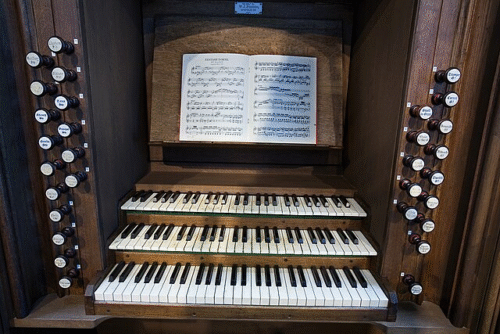
But pipe organs make it complicated. Really complicated. Each pipe only gives you one note, so if you want a scale, you’ll need a whole family of pipes in different sizes. These families, called ranks, share the same tone and volume, like siblings who all inherited the same singing voice. Most organs have lots of ranks, each with a distinct voice. Stops are used to control which ranks are used at any time. This allows the player to create sounds ranging from flute-like sweetness one minute to an earthquake-level rumble the next.
Creative Commons Attribution-Share Alike 3.0
And playing the thing isn’t just a matter of sitting down and managing the keys. The organist commands multiple keyboards with the hands, while the feet dance away on a pedal board, which functions like an additional keyboard for the baseline, or sometimes its own set of pipes. Beyond these, many stops line up beside the keyboard waiting for their turn to get in on the action. Considering I can barely walk and talk at the same time, this is mind boggling.

Public domain
And if that weren’t enough, some organs have multiple keyboards each which controls its own division of pipes, and the whole contraption—the keys, pedals, and stops—sit inside a console, which looks suspiciously like a something Captain Nemo played in the Nautilus.
So then, how did ‘pulling out all the stops’ become a metaphor for giving everything we’ve got? That happened in the 1800s. The first time someone used it figuratively was in 1865, by poet Matthew Arnold. He wrote about the “stop knobs” of an organ as a metaphor for how much effort someone might put in. Makes sense, since the stops controlled how many of the pipes would play at a given moment. Pulling out all the stops would result in a thunderous sound, produced by everything the organ had to bring to bear.
All of which means that I can use the expression in my books set in 1870, but probably need to avoid it for the dragon series in then 1810’s. Great to know, but one more thing I need to keep track of now. But still probably easier than playing a pipe organ!
References
Minute Media. 2025. “Where Does the Expression ‘Pull Out All the Stops’ Come From?” Mental Floss, April 2025. Accessed Sept 2, 2025 https://www.mentalfloss.com/pull-out-all-the-stops-meaning-origins Mental Floss
Merriam-Webster. n.d. “What Does It Mean to ‘Pull Out All the Stops’?” Merriam-Webster, Accessed Sept 2, 2025. https://www.merriam-webster.com/wordplay/pull-out-all-the-stops-phrase-history-pipe-organ Merriam-Webster
The Tabernacle Choir at Temple Square. n.d. “Where Does the Saying, ‘Pull Out All the Stops’ Come From?” The Tabernacle Choir, Accessed Sept 2, 2025. https://www.thetabernaclechoir.org/articles/pull-out-all-the-stops.html?lang=eng Tabernacle Choir
Very interesting! Thank you for posting. I really enjoy your deep dives.