
A Primer of Regency Social Calls
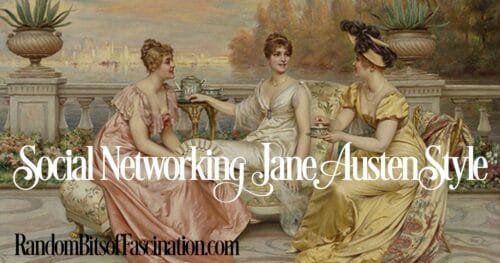
To a modern observer, the Georgian and Regency practice of paying social calls might seem like a quaint, painfully formal custom. However, these visits were not mere pleasantries. They were the fundamental mechanisms for making one’s way through a highly stratified society.
Every call made—or left unmade—was a strategic move in a complex social game. A single visit could irrevocably alter one’s social existence, possibly forging a valuable connection, or creating an acquaintance one could not escape in the future. Reputations, even marital prospects were created in this intricate web of unwritten rules, timed visits, and symbolic gestures. (Does this sound like any dragons we know?)
Knowing why and when to pay a call was just as important as the visit itself. Different types of visits had their own purpose, timing, and level of formality. A failure in observing these distinctions could be interpreted as a sign of ignorance or, worse, a deliberate social slight.
Formal Calls
Formal calls were obligatory visits dictated by etiquette, required to acknowledge specific social events. They maintained the proper courtesies and reinforced social bonds. The primary occasions for a formal call were:
Acknowledging Hospitality: A call was required as a “thank you” after being entertained. Etiquette dictated leaving a card the day after a ball, visiting within a day or two of a dinner party, and within a week of a smaller party.
Offering Congratulations: Visits were expected to celebrate significant life events, most notably a marriage or childbirth. A call to congratulate a newly married couple could be made up to two months after their wedding.

Expressing Condolences: Following a death or serious illness, calls of condolence were typically made about a week after the event. Unless the acquaintance was an intimate one, this often involved simply leaving a card rather than visiting in person, to avoid intruding on the family’s grief.
Part of an estate mistress’s duties was to look after less fortunate neighbors, so she might call upon them every week or two. On such visits, she might deliver food and medicinal preparations made in her own kitchen and stillroom, give advice, and lend an ear to their complaints. These visits were often the only support system for the indigent in the neighborhood.
The “At Home” Day
To manage the constant flow of visitors and bring order to a hectic social life, many ladies designated a specific day of the week as their “At Home” day. On this day, she would be available to receive any and all visitors who wished to call. This information was sometimes engraved on her calling card, providing a clear public schedule for her social circle. The “At Home” day was a practical system that prevented wasted journeys and ensured that social obligations could be met with efficiency and grace.
Not all visits were formal. obligatory ones. Come by next time to explore the world of the morning call.
Find more in the series HERE
References
Ashcraft, Jenny. “Let Me Leave You My Card.” Fishwrap (blog), August 13, 2020. https://blog.newspapers.com/let-me-leave-you-my-calling-card/
Beeton, Isabella. Mrs. Beeton’s Book of Household Management. Project Gutenberg, 2006. https://www.gutenberg.org/ebooks/10136.
Boyle, Laura. “Paying Social Calls.” Jane Austen Centre (blog), June 20, 2011. https://janeausten.co.uk/blogs/regency-history/paying-social-calls.
Golden, Paullett. “Calling Cards & Paying Calls: Social Etiquette in Georgian England.” Paullett Golden Romance (blog), May 31, 2022. https://www.paullettgolden.com/post/calling-cards-paying-calls-social-etiquette-in-georgian-england.
Green, Claire. “Calling Cards and Visiting Cards: A Brief History.” Hoban Cards (blog), September 12, 2016. https://hobancards.com/blog/calling-cards-and-visiting-cards-a-brief-history.
Hoppe, Michelle. “Calling Cards and the Etiquette of Paying Calls.” Literary Liaisons, 2000. http://www.literaryliaisons.com/article001.html.
Knowles, Rachel. “Visiting cards in the Regency.” Regency History (blog), June 1, 2022. https://www.regencyhistory.net/2022/06/visiting-cards-in-regency.html.
Odegaard, Kirstin. “Let’s Get Social: Morning Calls and Calling Cards in Austen’s Day.” Always Austen (blog), September 30, 2024. https://alwaysausten.com/2024/09/30/lets-get-social-morning-calls-and-calling-cards-in-austens-day.
Parkes, Mrs. William. Domestic Duties: or Instructions to young married ladies…. J&J Harper. New York: New York. 1829 Internet Archive. https://archive.org/details/domesticdutiesor00park_0/page/n5/mode/2up
Phillis, Edward. “Impressing the Neighbours, Georgian style.” Strictly Jane Austen (blog), June 8, 2022. https://www.strictlyjaneausten.com/impressing-the-neighbours-georgian-style.
Richmond, Arietta. “The Art of the Calling Card: Strict Etiquette and Social Interactions.” Arietta Richmond – Author (blog), August 10, 2025. https://ariettarichmond.com/the-art-of-the-calling-card-strict-etiquette-and-social-interactions.
Sanborn, Vic. “The Etiquette of Using Calling Cards.” Jane Austen’s World (blog), May 21, 2007. https://janeaustenworld.com/2007/05/21/the-etiquette-of-using-calling-cards.
Comments
A Primer of Regency Social Calls — No Comments
HTML tags allowed in your comment: <a href="" title=""> <abbr title=""> <acronym title=""> <b> <blockquote cite=""> <cite> <code> <del datetime=""> <em> <i> <q cite=""> <s> <strike> <strong>