
A Queen of Mobiity

By the late nineteenth century, Queen Victoria was one of the most recognizable women in the world. Every public appearance sent signals about what was proper, respectable, and acceptable. So, when the Queen began using a Bath chair in her later years, people noticed. And quietly, attitudes began to change.
A Practical Solution for an Aging Monarch
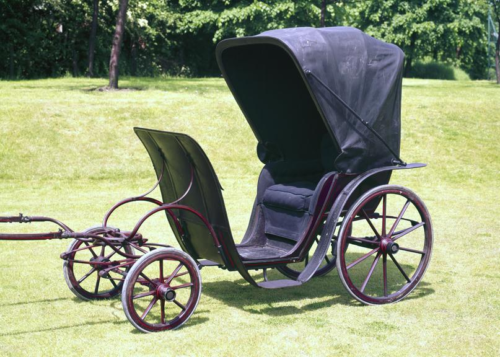
As Queen Victoria grew older, moving comfortably became more difficult. Rather than retreat from public life, she adopted a practical solution: the Bath chair.
One surviving example of her equipment is a pony-drawn Bath chair built in 1893 by R. Bird Cheverton and Company. Designed for stability and comfort, the chair allowed the Queen to continue traveling outdoors while minimizing physical strain. It featured a protective apron, sprung frame, and was pulled by a small pony led by a footman, ensuring a smooth and dignified ride.
By this point, the Bath chair was already well established as a wheeled mobility device originally developed in the eighteenth century to help visitors navigate spa towns such as Bath. These chairs were commonly used by individuals experiencing illness, injury, or age-related limitations. What made Victoria’s use remarkable was not the technology itself. It was the visibility.
Royal Visibility and Social Permission
In Victorian society, physical weakness often become social invisibility. Many individuals with mobility limitations were expected to withdraw from public life. The Bath chair offered a way to remain present, but stigma still lingered. When the Queen herself appeared in a mobility chair, it changed the social equation. If the monarch could use a device openly, then the device could not be shameful. Instead, it became practical, even respectable.
In the nineteenth century, the word “invalid” described people dealing with chronic illness or disability. The Bath chair itself was often described as an “invalid carriage.” Yet Victoria’s public use subtly shifted the emotional tone of that label. Her visibility reinforced the idea that physical limitations did not remove one from society. Participation remained possible.
Instead of suggesting frailty alone, mobility devices signaled adaptation. The Queen’s example demonstrated that needing assistance did not diminish one’s identity or social role.
Her use of the Bath chair also reflected a broader nineteenth-century shift toward technological solutions that increased independence. The same period saw improvements in prosthetics, hearing devices, and transport design. Mobility aids slowly became tools of participation rather than symbols of withdrawal.
Today, mobility devices are recognized as tools that enable independence and participation. That idea did not appear overnight. It developed gradually, shaped by inventors, users, and occasionally by queens willing to be seen in the act of adaptation.
What do you think? Tell me in the comments.
Read more about Sedan chairs, Bath Chairs, and other modes of transportation here.
References
Carriage Foundation. “Bath Chair.” Carriages of Britain. 2026.. https://www.thecarriagefoundation.org.uk/item/bath-chair-1
Carriage Foundation. “Invalid Carriage.” Carriages of Britain. https://www.thecarriagefoundation.org.uk/item/invalid-carriage-bristol
Davidson, Lucy. “When Was the Wheelchair Invented?” History Hit. April 14, 2022. https://www.historyhit.com/when-was-the-wheelchair-invented/
Doe & Hope. “A Wonderful Mid 19thC Invalid Carriage / Bath Chair c.1854.” Doe & Hope. Accessed February 26, 2026. https://www.doeandhope.com/en-us/products/a-wonderful-mid-19thc-invalid-carriage-bath-chair-c-1854
Fawcett, Trevor. “Chair Transport in Bath: The Sedan Era.” Bath History. https://historyofbath.org/images/BathHistory/Vol%2002%20-%2005.%20Fawcett%20-%20Chair%20Transport%20in%20Bath%20-%20The%20Sedan%20Era.pdf
Living Made Easy. “UK Disability History Month: The History of the Wheelchair.” Living Made Easy. 2026. https://livingmadeeasy.org.uk/advice-articles/history-of-the-wheelchair
Love, Suzi. “18th-19th Century Sedan Chair Travel In Jane Austen’s Times.” Suzi Love (blog). May 25, 2024. https://www.suzilove.com/?p=19067
Museum of Bath at Work. “Bath Chair – Museum of Bath at Work.” BBC – A History of the World. 2014. https://www.bbc.co.uk/ahistoryoftheworld/objects/popk2AxUQ5iEpgTQqnPiiQ
National Trust Collections. “Bath Chair, late nineteenth century.” Accessed March 23, 2026. https://www.nationaltrustcollections.org.uk/object/10542 (nationaltrustcollections.org.uk)
Science Museum Group. 2025. “Queen Victoria’s Pony Bath Chair.” https://collection.sciencemuseumgroup.org.uk/objects/co25493/queen-victorias-pony-bath-chair
Science Museum. 2025. “History of the Wheelchair.” https://www.sciencemuseum.org.uk/objects-and-stories/history-wheelchair
Tenby Museum. “Victorian Bath Chair.” BBC – A History of the World. 2014. https://www.bbc.co.uk/ahistoryoftheworld/objects/5Wfs5HOZSaOexY_vaHpMRQ
Zhao, Grace. “Wheelchairs & The Developing World.” The Borgen Project (blog). July 29, 2013. https://borgenproject.org/what-could-the-wheelchair-do-for-the-developing-world/
Comments
A Queen of Mobiity — No Comments
HTML tags allowed in your comment: <a href="" title=""> <abbr title=""> <acronym title=""> <b> <blockquote cite=""> <cite> <code> <del datetime=""> <em> <i> <q cite=""> <s> <strike> <strong>