
The Original Uber: Surprising Facts About Georgian and Victorian Travel
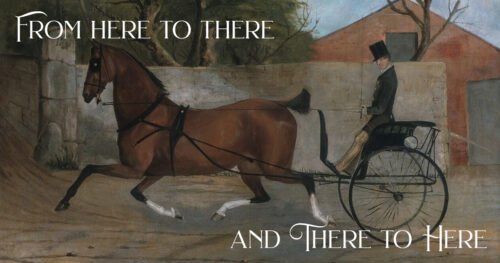
Getting from here to there has been a challenge for long as there has been a ‘here’ to be and a ‘there’ to get to. Travel always offered unique challenges and dangers in every era. For 18th and 19th century England, urban travel included streets choked with filth, raw sewage, and a level of congestion that would make a modern commuter shudder. For a lady dressed in delicate silks or a gentleman bound for a masquerade, the simple act of crossing the street was a high-stakes gamble.
The danger wasn’t merely the mud; it was the social catastrophe of exposure. Later in that period, when catching a glimpse of a lady’s leg as she stepped from a carriage could be considered scandalous, the elite required a solution that prioritized both sanitation and privacy. The answer was a masterclass in inventive engineering and social theater: Sedan and Bath chairs. These specialized vehicles were the luxury ride-shares of their day, at times even more convenient that our modern services can offer.
Join me for a quick peek at the history and social impact of these forgotten vehicles that defined the lifestyles of the Georgian and Victorian eras.
1. Better than door to door—parlor to parlor service.
The sedan chair offered a unique social advantage that no modern automobile can replicate: the ability to cross the threshold of the home. A small, portable kiosk, the sedan chair was designed for absolute privacy. Some were even minor works of art, featuring painted panels, elegant upholstery, and curtains across the windows.
Because the chair was carried by two “chairmen” using 80-inch poles, it could navigate stairs and hallways with ease. A passenger could be picked up in their own parlor and deposited directly into the cozy parlor destination without ever encountering the street’s elements or prying eyes. For ladies and partygoers, this was the ultimate luxury: maintaining one’s fashion and reputation surrounded by modern comfort and ease.
2. It began with a single step: Princess Amelia’s 100 mile journey.
While sedan chairs were primarily intended for short urban hops, they were occasionally used for long journeys. Perhaps the longest occurred in 1728, when Princess Amelia, a daughter of King George II, traveled from London to Bath. She made the 107-mile (172 km) journey entirely by sedan chair. The journey required eight chairmen working in shifts to carry the princess across the English countryside.
The princess, who suffered from various ailments, was considered an invalid. The sedan chair provided a smoother, more stable ride than the jolting, unsprung carriages of the early 18th century, making it far more tolerable than a carriage.
3. Why One Chairman Was Better Than Two
Around 1750, James Heath of Bath invented a vehicle that would eventually disrupt the sedan chair’s dominance: the Bath Chair. It was named not only for its city of origin, not so much for its curious physical similarity to an old-fashioned bathtub. Later refined by John Dawson, the Bath Chair featured two large rear wheels joined by an axle and a smaller pivoting cater-type wheel in the front, possibly cushioned by comfortable C-springs, and often equipped with a hood leather apron to protect the passenger from the rain.
The shift from the sedan to the Bath chair was fueled by a practical economic truth: it cut labor costs in half, one chairman to push instead of two to carry. Furthermore, the Bath Chair granted the occupant a radically new level of agency. By using a steering tiller or long rod connected to the front wheel, the passenger—not the servant—controlled the direction of travel.
4. High-Fashion Accessories
Modern assumptions often view wheelchairs as necessary mobility aids, but in the 18th and 19th century, they were actually high-fashion accessories for the status-conscious. While they were indispensable for those seeking the “healing waters” of British spas, healthy ladies used them as private, enclosed modes of transport to avoid the public gaze during brief trips.
The interiors were as opulent as a first-class cabin. The 1851 Great Exhibition featured a Bath Chair with elaborate decorative panels painted with the “Four Seasons.”
5. Queen Victoria’s “Rolling Chaise” Legacy
Queen Victoria solidified the Bath Chair into a symbol of dignified mobility. In her later years, particularly leading up to her Diamond Jubilee in 1897, the Queen relied heavily on these “rolling chaises” to maintain her busy schedule.
Victoria’s endorsement transitioned the technology from a luxury of the wealthy to a precursor of modern mobility. This royal usage helped destigmatize the use of mobility aids, framing the Bath Chair as a tool of independence rather than a sign of frailty.
References
Carriage Foundation. “Bath Chair.” Carriages of Britain. 2026.. https://www.thecarriagefoundation.org.uk/item/bath-chair-1
Carriage Foundation. “Invalid Carriage.” Carriages of Britain. https://www.thecarriagefoundation.org.uk/item/invalid-carriage-bristol
Davidson, Lucy. “When Was the Wheelchair Invented?” History Hit. April 14, 2022. https://www.historyhit.com/when-was-the-wheelchair-invented/
Doe & Hope. “A Wonderful Mid 19thC Invalid Carriage / Bath Chair c.1854.” Doe & Hope. Accessed February 26, 2026. https://www.doeandhope.com/en-us/products/a-wonderful-mid-19thc-invalid-carriage-bath-chair-c-1854
Living Made Easy. “UK Disability History Month: The History of the Wheelchair.” Living Made Easy. 2026. https://livingmadeeasy.org.uk/advice-articles/history-of-the-wheelchair
Love, Suzi. “18th-19th Century Sedan Chair Travel In Jane Austen’s Times.” Suzi Love (blog). May 25, 2024. https://www.suzilove.com/?p=19067
Museum of Bath at Work. “Bath Chair – Museum of Bath at Work.” BBC – A History of the World. 2014. https://www.bbc.co.uk/ahistoryoftheworld/objects/popk2AxUQ5iEpgTQqnPiiQ
Tenby Museum. “Victorian Bath Chair.” BBC – A History of the World. 2014. https://www.bbc.co.uk/ahistoryoftheworld/objects/5Wfs5HOZSaOexY_vaHpMRQ
Zhao, Grace. “Wheelchairs & The Developing World.” The Borgen Project (blog). July 29, 2013. https://borgenproject.org/what-could-the-wheelchair-do-for-the-developing-world/
Fascinating! Thank you for sharing this research!
Yes, fascinating. I am surprised regency writers never mention them. At least, I don’t recall having come across it.