
Dancing the Minuet
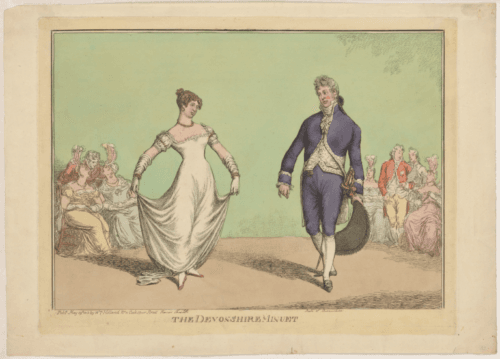
During the Georgian Era, dancing was considered a genteel activity, enjoyed by all stations. Dancing trained young people, both boys and girls in deportment. The way a person moved along the dancefloor revealed his or her class, their education, and breeding. To dance poorly was a social faux pax, at best, a nightmare for one’s reputation and image at worse.
The minuet originated during the Georgian era in France, as a dance for two people written in ¾ time. As was often the case, the minuet made its way into England during the 1700s. One particular version of the minuet, the Menuet de la Cour was introduced to London in 1781, as part of the ballet-pantomime Ninette à la Cour. It contained many traditional minuet figures, but incorporated a number of steps beyond the traditional which may have made it the basis for the exacting exhibition dances performed in the late 1700s and early 1800s when formal balls would begin with an exhibition of the minuet.
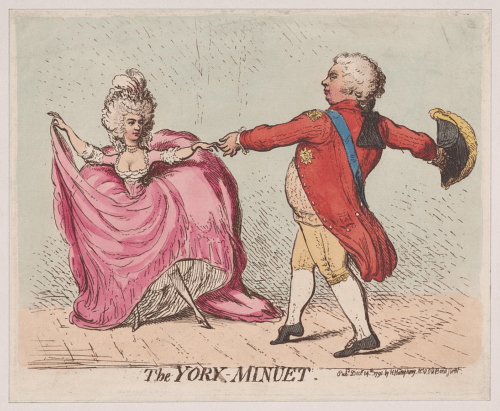
Some suggest the minuet was dying out during the Regency Era, but period newspapers reveal that it was still taught during the first two decades of the 1800s based on the advertisements of dance masters. Thomas Wilson (The Morning Post for 23 January 1810) included minuets in the list of dances taught, alongside cotillions and country dances. Mr. Levine (Morning Post for 12 November 1819) offered quadrilles, country dances, waltzes and minuets to his dance pupils. All of which suggests the minuet was still relevant during the Regency Era (and certainly appropriate for the Dragon Keeper’s Cotillion.)
Dancing the Minuet
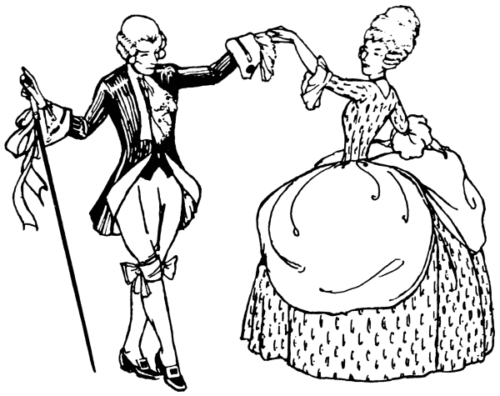
When the minuet was performed, it was by one couple at a time, in a rigidly prescribed order based on social rank. The highest ranking couple began the dance. At a particular point, the man would withdraw and the next highest ranking gentleman with dance with the highest ranking lady. Then the lady would withdraw to be replaced by the next highest-ranking lady, and so on, until all the dancers had their moment in the spotlight. Though I haven’t seen historians say this, I have a feeling one of the reasons for the decline popularity of the minuet was that it left nearly everyone standing around watching for a great deal of the party, sometimes up to half the evening, which is decidedly not as much fun as getting to dance.
Moreover, the minuet was a precise, exacting dance requiring accurate foot work and a great deal of grace to do it justice. While there certainly would have been those who enjoyed showing off of for the attention their excellent dancing would have attracted, I’m pretty sure there were at least as many who dreaded the ordeal and rejoiced when the danced faded away.
The video below will give you some sense of what the minuet was like.
A bit of instruction on the minuet in the Bath Assembly Rooms
References
https://danceinhistory.com/2019/02/18/le-menuet-de-la-cour/
https://danceinhistory.com/2021/10/01/the-regency-minuet/
https://yorkregencydancers.com/regency-dance/
:O
I would not have been able to get married if that was required, I loved the video!
Learning the waltz was enough for me! Some of those dances required too much skipping, jumping, and turning.
After reading about the Blue Order Cotillion in your books, I started scouring YouTube for dance videos showing how it was done, but had missed this one! I appreciate the research you do to ensure your books are accurate to the time period!
Pingback:Top Ten Most Fascinating of 2025 - Random Bits of Fascination
Seventy years ago, my British parents came back from my dad’s math department skating evening and announced they had stunned the group by dancing the minuet on skates. Their American colleagues and the wives had never seen the minuet danced. The only time I saw it was at my parents’ next party, when popular request had them dance it again in our living room.
Seeing this video, I cannot imagine how they managed this dance on skates!
My mother did not dress in costume neither of these two occasions, but she could have. She had a elegant Marie Antoinette gown and wig that had been made before an ocean journey that she knew would culminate in a masquerade the final evening on board ship.