
A Beginner’s Guide to Calling Card Etiquette
Before smartphones and social networks, a simple piece of cardstock was the most sought after tool for navigating high society. From the late 18th to the early 20th centuries, the calling card was the essential instrument for initiating contact, maintaining one’s social standing, and managing the intricate web of personal relationships.
These cards were far more than a name on paper; they were part of a complex system of rules and coded messages that could make or break a reputation.
Anatomy of a Calling Card
The design and content of calling cards evolved throughout the period, but they remained a potent symbol of one’s social standing. The cards of the Regency, in particular, were defined by a minimalist elegance that stood in contrast to the ornate embellishments of the later Victorian era.
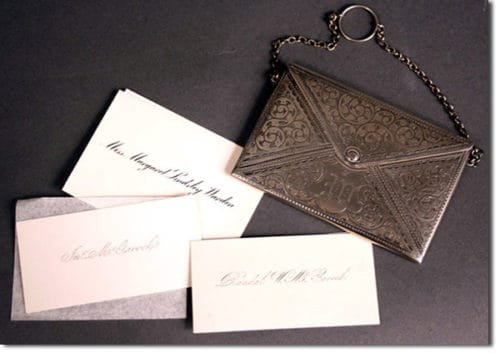
Size and Shape: Cards were typically small and rectangular. While a common convention held that a gentleman’s card was smaller and narrower to fit easily into a breast pocket, and a lady’s was slightly larger and more squarish, the reality showed considerable variation. Calling cards in the British Museum’s collection reveal that some gentlemen used cards as large and elaborate as those of their female counterparts.
Material and Design: Made of fine parchment or cardstock, simplicity characterized Regency-era cards. Preferences favored unadorned, plain cards with the name engraved in a simple script, sometimes by distinguished engravers. In contrast, Victorian preferences leaned toward colors, fringe, romantic imagery, and elaborate designs.
This preference for elegant simplicity reflected the Neoclassical tastes of the Regency, where understated class was valued over the conspicuous displays of wealth that would later define the Victorian period.
Information: The information on a card was precise and socially coded. It typically included the person’s name preceded by a simple ‘Mr.’ or ‘Mrs.’, along with any title of rank (e.g., Earl). A military officer might include his regiment. A married woman’s card always bore her husband’s full name, such as “Mrs. Fitzwilliam Darcy,” never her own first name. To distinguish himself from his father, a son might use his full name, such as “Mr. Fitzwilliam Darcy.” The names of any unmarried adult daughters living at home would be printed on their mother’s card.
While early cards bore only a name and title, by the end of the 1800s it was not uncommon to see an address or a lady’s designated “at home” day included.
A Secret Language of Calling Cards
The way a card was presented or altered could convey a specific message without a single word being written. Folding a corner of a card was a form of silent communication, with each corner having a distinct meaning. Though the specific meanings could vary by region and were not universally standardized, the following were common.
Upper Right Corner: Folding this corner signified that the card was delivered in person by the caller, rather than by a servant.
Upper Left Corner: This fold was used to express congratulations, perhaps for a wedding or a birth in the family.
Lower Left Corner: This corner was folded to offer sympathy or condolences following a death or illness.
Lower Right Corner: A fold here indicated a farewell visit. It meant the caller was leaving the area for a trip and that no return call was expected. Callers might instead note P.P.C. on the card. This stood for pour prendre congé, which translates to “to take leave.”
Some of the most elaborate cards even had the purpose of the visit (such as Felicitation, Visite, or Adieu) printed on the reverse side of the corners to make the message explicit when folded.
Next time we’ll explore how these cards were used as a currency in the process of social networking.
Find more in the series HERE
References
Ashcraft, Jenny. “Let Me Leave You My Card.” Fishwrap (blog), August 13, 2020. https://blog.newspapers.com/let-me-leave-you-my-calling-card/
Beeton, Isabella. Mrs. Beeton’s Book of Household Management. Project Gutenberg, 2006. https://www.gutenberg.org/ebooks/10136.
Boyle, Laura. “Paying Social Calls.” Jane Austen Centre (blog), June 20, 2011. https://janeausten.co.uk/blogs/regency-history/paying-social-calls.
Golden, Paullett. “Calling Cards & Paying Calls: Social Etiquette in Georgian England.” Paullett Golden Romance (blog), May 31, 2022. https://www.paullettgolden.com/post/calling-cards-paying-calls-social-etiquette-in-georgian-england.
Green, Claire. “Calling Cards and Visiting Cards: A Brief History.” Hoban Cards (blog), September 12, 2016. https://hobancards.com/blog/calling-cards-and-visiting-cards-a-brief-history.
Hoppe, Michelle. “Calling Cards and the Etiquette of Paying Calls.” Literary Liaisons, 2000. http://www.literaryliaisons.com/article001.html.
Knowles, Rachel. “Visiting cards in the Regency.” Regency History (blog), June 1, 2022. https://www.regencyhistory.net/2022/06/visiting-cards-in-regency.html.
Odegaard, Kirstin. “Let’s Get Social: Morning Calls and Calling Cards in Austen’s Day.” Always Austen (blog), September 30, 2024. https://alwaysausten.com/2024/09/30/lets-get-social-morning-calls-and-calling-cards-in-austens-day.
Parkes, Mrs. William. Domestic Duties: or Instructions to young married ladies…. J&J Harper. New York: New York. 1829 Internet Archive. https://archive.org/details/domesticdutiesor00park_0/page/n5/mode/2up
Phillis, Edward. “Impressing the Neighbours, Georgian style.” Strictly Jane Austen (blog), June 8, 2022. https://www.strictlyjaneausten.com/impressing-the-neighbours-georgian-style.
Richmond, Arietta. “The Art of the Calling Card: Strict Etiquette and Social Interactions.” Arietta Richmond – Author (blog), August 10, 2025. https://ariettarichmond.com/the-art-of-the-calling-card-strict-etiquette-and-social-interactions.
Sanborn, Vic. “The Etiquette of Using Calling Cards.” Jane Austen’s World (blog), May 21, 2007. https://janeaustenworld.com/2007/05/21/the-etiquette-of-using-calling-cards.
Comments
A Beginner’s Guide to Calling Card Etiquette — No Comments
HTML tags allowed in your comment: <a href="" title=""> <abbr title=""> <acronym title=""> <b> <blockquote cite=""> <cite> <code> <del datetime=""> <em> <i> <q cite=""> <s> <strike> <strong>