
The Ritual of the Morning Call
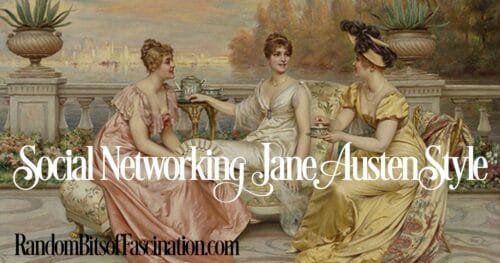
Morning calls were more routine, less structured visits intended for maintaining friendships and exchanging news. The term “morning call” is a source of confusion for modern readers, as these visits almost always took place in the afternoon. The proper hours were typically between 1 p.m. and 4 p.m. in town and from 11 a.m. to 3 p.m. in the country. This timing was carefully chosen to avoid intruding upon a family’s breakfast or dinner hours.
The process followed three critical steps:
Being Received
A visitor would often remain in their carriage while a servant (a groom or footman) took their card to the door. The card was handed to the servant of the house, who would convey it to the mistress. (Pets and children, both regarded as potentially destructive and annoying, were not welcome on morning calls.)
A proper social call had a precise timeframe of 15 and 30 minutes, with 20 minutes being ideal. To stay for less than 15 minutes was a direct insult, implying the visit was a mere obligation. To stay longer than 30 minutes was an imposition on the hostess’s time.
What to do during a social call
The heart of polite sociability was conversation. The whole purpose of conversation was to please other people and to be deemed pleasing. In general, conversation was tightly controlled by rules of etiquette as well. Unsurprisingly, the list of unacceptable topics far outnumbered the acceptable ones. In mixed company, acceptable subjects included the weather, the health of family members, fashion, and upcoming social events. Scandal, business, money, and anything related to the physical body, such as pregnancy and childbirth were to be strictly avoided. More on that HERE
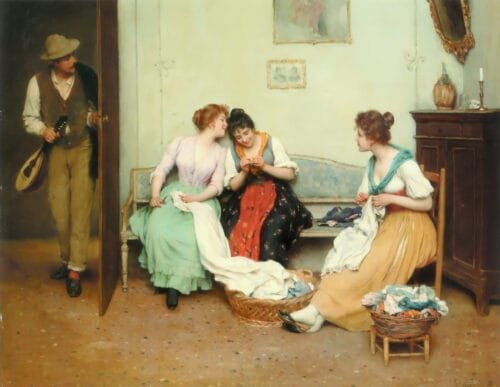
In order to take advantage of afternoon light, women would work on their needlework during a call. Even in wealthy households, a great deal of a woman’s time was spent sewing. Often, the woman of the house made her husband’s shirts, according to patterns handed down through the family. Simple body linen and nightdresses might also be made at home. Estate mistresses might make baby dresses and children’s clothes for the neighborhood poor. Sometimes visitors brought their own work or the hostess would offer her visitors pieces to work on. It was considered more genteel to apply oneself to ‘fancywork’ (often embroidery or decorative needlework) rather than ‘plain’ shirt-making or mending.
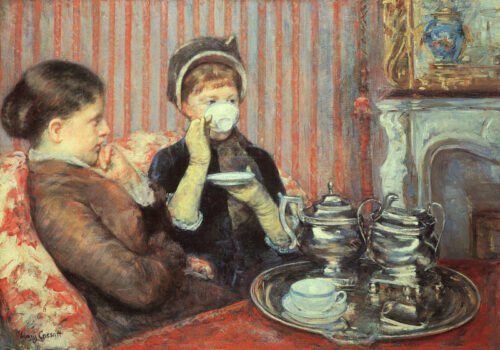
Light refreshments were expected, with the offering varying by the host’s wealth. A modest household might offer cake, baked apples, or cold meats, while a wealthier one could provide seasonal fruits and sandwiches. However, tea was generally not served during morning calls.
Due to its high price, tea was an expensive commodity reserved for breakfast or after-dinner entertaining. To be offered tea during a morning call was highly significant, either a sign of extreme favor, perhaps a lavish attempt to impress a guest. Or, more cynically, it could be a sign that the tea itself was of poor quality—perhaps smuggled, adulterated with sheep’s dung, or made from re-used leaves. More about tea HERE.
The etiquette of departure was as important as the arrival. A polite guest stayed no longer than 30 minutes. If a new visitor arrived while a call was in progress, though, the first caller was expected to take their leave shortly thereafter to allow the hostess to attend to the new guest.
Strict Reciprocity
The system was governed by an unwavering principle of reciprocity: a call must be returned with a call, and a card with a card. This return was expected promptly, ideally the next day but certainly within a week. Failure to reciprocate was not a casual oversight but an unmistakable snub, a deliberate choice that effectively severed an acquaintance. In Pride and Prejudice, when Caroline Bingley waits three weeks to return Jane Bennet’s visit, she is not merely being forgetful; she is clearly slighting her.
The Meaning of “Not at Home”
If a servant returned to a caller with the message that the mistress was “not at home,” this was not necessarily a literal statement. It was a polite, face-saving social convention with several potential meanings. It could signal that the resident was simply occupied and not receiving visitors at that moment, or it could be a gentle way of declining the acquaintance without causing direct offense.
“As the words ‘not at home’ have become synonymous with ‘being engaged’, they neither deceive, nor are intended to deceive…” —Mrs. Parkes, Domestic Duties (1825)
Being asked to wait outside while the footman “checked” was a moment of high social tension. A long delay was a public signal to any passersby that the caller was unwelcome and that their request for an audience was being debated within, a potentially devastating blow to one’s social standing. The subsequent action was telling: if the servant offered a reciprocal card from the mistress, it signaled that a return visit was welcome. If the servant simply relayed the message and shut the door, it was a clear sign that the acquaintance was not desired. Ouch!
Find more in the series HERE
References
Ashcraft, Jenny. “Let Me Leave You My Card.” Fishwrap (blog), August 13, 2020. https://blog.newspapers.com/let-me-leave-you-my-calling-card/
Beeton, Isabella. Mrs. Beeton’s Book of Household Management. Project Gutenberg, 2006. https://www.gutenberg.org/ebooks/10136.
Boyle, Laura. “Paying Social Calls.” Jane Austen Centre (blog), June 20, 2011. https://janeausten.co.uk/blogs/regency-history/paying-social-calls.
Golden, Paullett. “Calling Cards & Paying Calls: Social Etiquette in Georgian England.” Paullett Golden Romance (blog), May 31, 2022. https://www.paullettgolden.com/post/calling-cards-paying-calls-social-etiquette-in-georgian-england.
Green, Claire. “Calling Cards and Visiting Cards: A Brief History.” Hoban Cards (blog), September 12, 2016. https://hobancards.com/blog/calling-cards-and-visiting-cards-a-brief-history.
Hoppe, Michelle. “Calling Cards and the Etiquette of Paying Calls.” Literary Liaisons, 2000. http://www.literaryliaisons.com/article001.html.
Knowles, Rachel. “Visiting cards in the Regency.” Regency History (blog), June 1, 2022. https://www.regencyhistory.net/2022/06/visiting-cards-in-regency.html.
Odegaard, Kirstin. “Let’s Get Social: Morning Calls and Calling Cards in Austen’s Day.” Always Austen (blog), September 30, 2024. https://alwaysausten.com/2024/09/30/lets-get-social-morning-calls-and-calling-cards-in-austens-day.
Parkes, Mrs. William. Domestic Duties: or Instructions to young married ladies…. J&J Harper. New York: New York. 1829 Internet Archive. https://archive.org/details/domesticdutiesor00park_0/page/n5/mode/2up
Phillis, Edward. “Impressing the Neighbours, Georgian style.” Strictly Jane Austen (blog), June 8, 2022. https://www.strictlyjaneausten.com/impressing-the-neighbours-georgian-style.
Richmond, Arietta. “The Art of the Calling Card: Strict Etiquette and Social Interactions.” Arietta Richmond – Author (blog), August 10, 2025. https://ariettarichmond.com/the-art-of-the-calling-card-strict-etiquette-and-social-interactions.
Sanborn, Vic. “The Etiquette of Using Calling Cards.” Jane Austen’s World (blog), May 21, 2007. https://janeaustenworld.com/2007/05/21/the-etiquette-of-using-calling-cards.
Comments
The Ritual of the Morning Call — No Comments
HTML tags allowed in your comment: <a href="" title=""> <abbr title=""> <acronym title=""> <b> <blockquote cite=""> <cite> <code> <del datetime=""> <em> <i> <q cite=""> <s> <strike> <strong>