
Paying the First Social Call
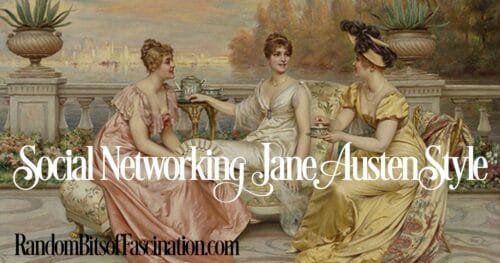
The initial call between two individuals or families carried tremendous social weight. This first contact was not merely a casual introduction but a formal negotiation that set the tone for the future of the relationship. It was governed by rules regarding social hierarchy and residency status. A misstep at this crucial stage could be a fatal blow to one’s social aspirations. (No unlike properly greeting a major dragon, but I digress).
It all began with knowing who was expected to make the first move.
The Newcomer’s Predicament
One of the most critical and unforgiving rules of etiquette was that a newcomer to a neighborhood had to wait to be called upon by the established residents. For a newcomer to initiate the first call would be seen as presumptuous and a major social blunder.
This is the source of Mrs. Bennet’s agitation in Pride and Prejudice. Until Mr. Bennet pays a call on the newly arrived Mr. Bingley, the Bingley family cannot visit the Bennets, and her daughters cannot be properly introduced. Mr. Bennet’s call is the necessary first move that opens the door for a reciprocal visit and, thus, a new acquaintance.
Town vs. Country: A Tale of Two Etiquettes

The rules for initiating contact differed significantly between the bustling social scene of London (“town”) and the more settled life of a rural area (“country”).
In a country neighborhood, the responsibility for the first call fell to the most established residents, who were expected to welcome newcomers. This duty often fell to figures like the local vicar. In the country, social rank was secondary to residency status. So, a long-standing, but socially inferior, resident would be expected to call on the newly arrived titled gentleman to welcome him.
In the far more hierarchical world of London, social rank was the determining factor. A person of a higher social station was always expected to initiate the first call on someone of a lower rank. The country scenario would be reversed: the esteemed titled gentleman and his wife would have to make the first move by calling on the socially inferior gentleman. For him to call on them first would be an unacceptable breach of protocol.
This difference in etiquette is why those who lived exclusively in the country were sometimes considered “bumpkins,” as they were unacquainted with the stricter rules of town life.
The Gentleman’s Role
In both town and country, gentlemen played a pivotal role in weaving new families into the local social fabric. It was customary for a gentleman to make the initial call on a new family. This act then enabled him to perform formal introduction of the newcomers to his own wife and daughters, who could then extend introductions to their wider circle of friends, thus integrating a new family into the community.
Once these rules of initiation were managed successfully, the practical execution of the social call itself came into play. Next time, we’ll explore exactly what a social call might entail.
Read more about social introductions HERE.
Find more in the series HERE
References
Ashcraft, Jenny. “Let Me Leave You My Card.” Fishwrap (blog), August 13, 2020. https://blog.newspapers.com/let-me-leave-you-my-calling-card/
Beeton, Isabella. Mrs. Beeton’s Book of Household Management. Project Gutenberg, 2006. https://www.gutenberg.org/ebooks/10136.
Boyle, Laura. “Paying Social Calls.” Jane Austen Centre (blog), June 20, 2011. https://janeausten.co.uk/blogs/regency-history/paying-social-calls.
Golden, Paullett. “Calling Cards & Paying Calls: Social Etiquette in Georgian England.” Paullett Golden Romance (blog), May 31, 2022. https://www.paullettgolden.com/post/calling-cards-paying-calls-social-etiquette-in-georgian-england.
Green, Claire. “Calling Cards and Visiting Cards: A Brief History.” Hoban Cards (blog), September 12, 2016. https://hobancards.com/blog/calling-cards-and-visiting-cards-a-brief-history.
Hoppe, Michelle. “Calling Cards and the Etiquette of Paying Calls.” Literary Liaisons, 2000. http://www.literaryliaisons.com/article001.html.
Knowles, Rachel. “Visiting cards in the Regency.” Regency History (blog), June 1, 2022. https://www.regencyhistory.net/2022/06/visiting-cards-in-regency.html.
Odegaard, Kirstin. “Let’s Get Social: Morning Calls and Calling Cards in Austen’s Day.” Always Austen (blog), September 30, 2024. https://alwaysausten.com/2024/09/30/lets-get-social-morning-calls-and-calling-cards-in-austens-day.
Parkes, Mrs. William. Domestic Duties: or Instructions to young married ladies…. J&J Harper. New York: New York. 1829 Internet Archive. https://archive.org/details/domesticdutiesor00park_0/page/n5/mode/2up
Phillis, Edward. “Impressing the Neighbours, Georgian style.” Strictly Jane Austen (blog), June 8, 2022. https://www.strictlyjaneausten.com/impressing-the-neighbours-georgian-style.
Richmond, Arietta. “The Art of the Calling Card: Strict Etiquette and Social Interactions.” Arietta Richmond – Author (blog), August 10, 2025. https://ariettarichmond.com/the-art-of-the-calling-card-strict-etiquette-and-social-interactions.
Sanborn, Vic. “The Etiquette of Using Calling Cards.” Jane Austen’s World (blog), May 21, 2007. https://janeaustenworld.com/2007/05/21/the-etiquette-of-using-calling-cards.
Comments
Paying the First Social Call — No Comments
HTML tags allowed in your comment: <a href="" title=""> <abbr title=""> <acronym title=""> <b> <blockquote cite=""> <cite> <code> <del datetime=""> <em> <i> <q cite=""> <s> <strike> <strong>