
Surprising Truths about Socializing in the Regency era.
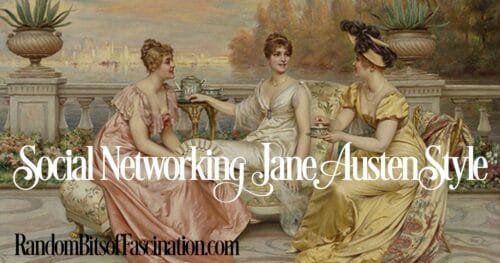
I’m about 20K words into the new dragon book. (Yay dragons!) And you know what that means, right? I’ve been deep diving in rabbit holes right and left!
Today’s rabbit hole is brought to you by the question: Does one need a calling card to pay a proper social call to a dragon?
When we picture Regency England, scenes of polite society making social calls often come to mind. We imagine ladies and gentlemen (and dragons) dropping in for a brief chat, perhaps over a cup of tea. Yet, beneath this polished veneer of civility lay a complex and rigid system of etiquette, governed by unspoken rules that would seem utterly counterintuitive to a modern observer.
The practice of leaving a visiting card was an indispensable accessory for social survival in Regency Britain, a strategic tool for navigating the treacherous waters of the social hierarchy, making connections, and delivering polite snubs.
Sounds positively draconic, doesn’t it? So, let’s dive in.
1. “Not At Home” Was a Socially Acceptable Lie
In the Regency era, if you called upon someone and their servant informed you that the lady of the house was “not at home,” there was a very good chance she was, in fact, sitting in her drawing-room just a few feet away. The phrase was a universally understood piece of social code, but its meaning depended entirely on who was calling. For an acquaintance, it was a polite fiction for “I’m too busy to receive visitors.” For a stranger, however, it could be a polite but firm rejection, a clear signal that “the person did not desire the acquaintance.”
The practice was not considered deceptive, though. On the contrary, it was a way to maintain social harmony by avoiding direct confrontation, allowing individuals to manage their social circles without causing offense.
It’s not hard to imagine dragons using this convention as a way to carefully avoid conflict with one another.
2. “Morning Calls” Happened in the Afternoon
In the Regency era’s social parlance, “morning” referred to the period between breakfast and dinner, which was served much later in the day.
The socially acceptable hours for making morning calls were typically between 1 p.m. and 4 p.m. in town. In the country, the hours were a bit earlier, usually from 11 a.m. to 3 p.m. This timing ensured a visitor would not intrude upon a family’s breakfast routine or interfere with their dinner preparations.
To add another layer of complexity, specific types of calls were allocated to different time slots. Formal, ‘ceremonial calls’ were made between three and four o’clock, semi-ceremonial calls between four and five, and intimate calls between five and six.
How draconic, to allow the timing of the visit to signal just how personal the call was.
3. Forget the Tea: Your Host Probably Wouldn’t Serve It
The image of sipping tea during a brief social call is largely a myth. While light refreshments might be offered, tea was exorbitantly expensive. Offering it to a steady stream of casual visitors would have been an extravagant expense for most households. An offer of good quality tea was a significant gesture, intended either to impress a high-status guest or to show exceptional kindness to a dear friend.
Refreshments were offered based on the host’s wealth. A well-off family might provide cold meats, seasonal fruits, or sandwiches, while a less affluent household might offer a slice of cake or some baked apples.
In fact, if a less affluent host did offer tea, it could be a sign of poor quality. The tea might be brewed from reused leaves or, more shockingly, adulterated with other substances like tree leaves and even sheep’s dung to bulk it out. (And no, I’m really not making this stuff up!)
Callers would be wise to be wary of what might be in the cup!

4. Calling Cards Were the Original Social Media Feed
Long before carefully curated Instagram profiles, the Regency elite displayed their social connections: the calling card tray.
In any fashionable home, a tray—a silver salver in wealthy households, a china bowl in less affluent ones—was kept in the entrance hall. When visitors called, they would leave their cards on this tray, displaying a record of who had stopped by; it was a public broadcast of the household’s social standing.
Cards would be arranged to ensure those from the most important and high-ranking visitors were placed prominently on top for all to see. A tray brimming with cards from influential people was a form of quiet name dropping and a display of silent superiority.
No dragon would ever do that, would they? 😉
5. A Simple Card Held a Coded Language
A calling card was also a medium for a subtle, coded language. By folding a corner, a visitor could convey specific information without needing to write a full message.
Some of the best-documented codes involved folding a specific corner of the card:
- Upper right-hand corner folded: The caller delivered the card in person, rather than sending a servant.
- Upper left-hand corner folded: A message of congratulations.
- Lower left-hand corner folded: An expression of condolences or sympathy.
- Lower right-hand corner folded: A farewell call before a trip
Hidden messages? Full on dragon behavior for sure!
The Regency calling card and the ritual of the social call were far more than simple pleasantries. They were part of a complex social performance, an art form for both connection and, just as importantly, exclusion. Doesn’t that sound utterly draconic?
Watch for more in this series coming soon!
Find more in the series HERE
References
Boyle, Laura. “Paying Social Calls.” Jane Austen Centre (blog), June 20, 2011. https://janeausten.co.uk/blogs/regency-history/paying-social-calls.
Golden, Paullett. “Calling Cards & Paying Calls: Social Etiquette in Georgian England.” Paullett Golden Romance (blog), May 31, 2022. https://www.paullettgolden.com/post/calling-cards-paying-calls-social-etiquette-in-georgian-england.
Green, Claire. “Calling Cards and Visiting Cards: A Brief History.” Hoban Cards (blog), September 12, 2016. https://hobancards.com/blog/calling-cards-and-visiting-cards-a-brief-history.
Hoppe, Michelle. “Calling Cards and the Etiquette of Paying Calls.” Literary Liaisons, 2000. http://www.literaryliaisons.com/article001.html.
Knowles, Rachel. “Visiting cards in the Regency.” Regency History (blog), June 1, 2022. https://www.regencyhistory.net/2022/06/visiting-cards-in-regency.html.
Odegaard, Kirstin. “Let’s Get Social: Morning Calls and Calling Cards in Austen’s Day.” Always Austen (blog), September 30, 2024. https://alwaysausten.com/2024/09/30/lets-get-social-morning-calls-and-calling-cards-in-austens-day.
Phillis, Edward. “Impressing the Neighbours, Georgian style.” Strictly Jane Austen (blog), June 8, 2022. https://www.strictlyjaneausten.com/impressing-the-neighbours-georgian-style.
Richmond, Arietta. “The Art of the Calling Card: Strict Etiquette and Social Interactions.” Arietta Richmond – Author (blog), August 10, 2025. https://ariettarichmond.com/the-art-of-the-calling-card-strict-etiquette-and-social-interactions.
Sanborn, Vic. “The Etiquette of Using Calling Cards.” Jane Austen’s World (blog), May 21, 2007. https://janeaustenworld.com/2007/05/21/the-etiquette-of-using-calling-cards.
Fascinating. Dragons would have to be careful not to breathe on the cards, though!
Thanks for this fascinating and useful post, Maria Grace!